
How to Distinguish Common Types of Engineered Wood
Learn how to distinguish common types of engineered wood such as MFC, MDF, HDF, and Plywood based on their structure, characteristics, and interior applications. This article also suggests suitable adhesives for engineered wood installation and furniture
Engineered wood is widely used in modern furniture manufacturing and interior construction. From wardrobes, desks, TV cabinets, kitchen cabinets, decorative wall panels to office furniture, users can easily find different types of engineered wood boards in many interior products. However, not everyone knows how to distinguish different types of engineered wood in order to choose the right material for each application.
Each type of engineered wood has a different structure, durability level, moisture resistance, workability, and price range. If the wrong type of board is chosen, the finished furniture may quickly deteriorate, warp, have peeling edges, or fail to achieve the desired appearance. On the other hand, when the right board core, surface finish, and adhesive are selected, the final product will be stronger, more attractive, and more stable during use.
Besides wood materials, adhesive is also an important factor in interior construction. For surfaces such as MDF, plywood, veneer, laminate, sofa foam, plywood boards, or joined wood details, workers need to use an adhesive with suitable bonding strength. In the interior adhesive category, products such as Keo Rồng Vàng P-66, S-Bond Premium Wood Glue, SB65 Spray Adhesive, SB8 Pro Spray Adhesive, and S-Bond Super 8 Spray Adhesive can support the bonding, joining, and finishing process of engineered wood products.
1. What Is Engineered Wood?
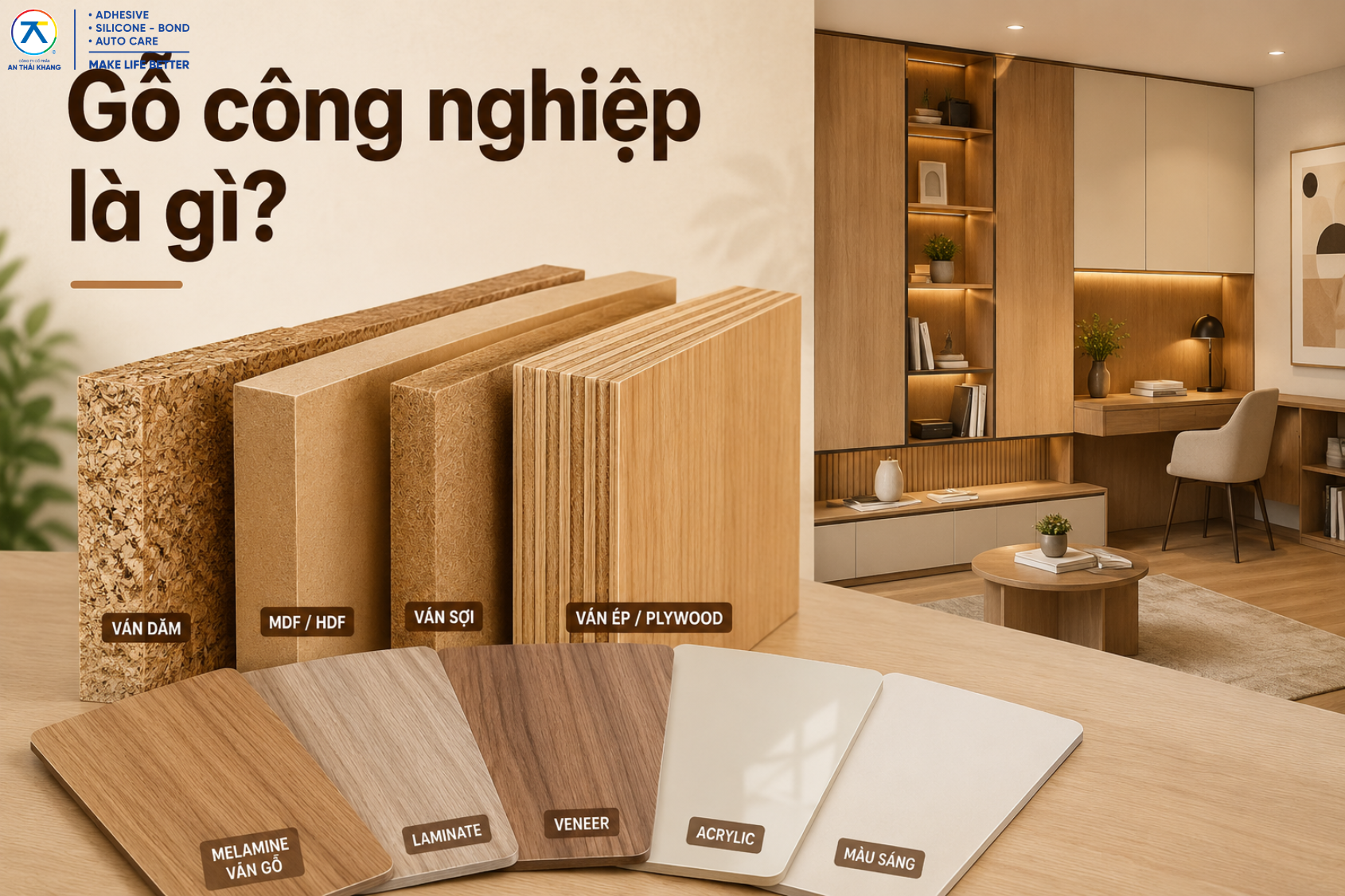
Engineered wood is a material made from wood chips, wood fibers, wood powder, or thin wood layers. These materials are combined with adhesives and additives, then pressed into boards under suitable heat and pressure. Unlike solid natural wood, engineered wood makes use of small wood pieces, wood waste, or plantation timber to create standard-sized boards.
The advantages of engineered wood include diverse designs, reasonable cost, easy processing, and suitability for many interior styles. Its surface can be finished with Melamine, Laminate, Veneer, Acrylic, or paint to enhance its appearance.
However, each type of board has its own usage limits. Some types are suitable for dry spaces, some have better moisture resistance, some are easier to shape, while others offer higher hardness and load-bearing capacity. Therefore, understanding how to distinguish different types of engineered wood is an important step before choosing materials for construction or furniture production.
2. Why Is It Important to Distinguish Different Types of Engineered Wood?
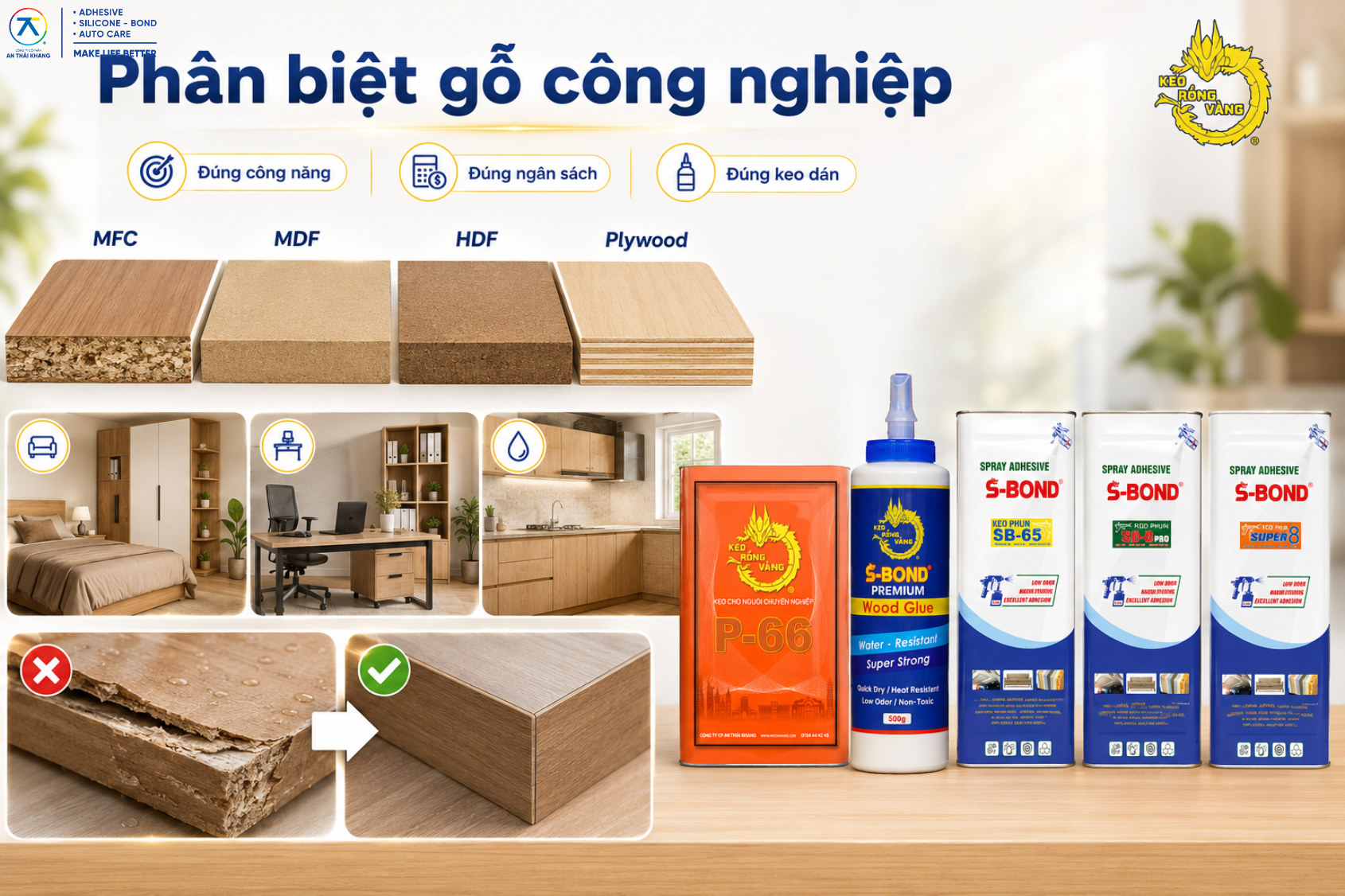
Correctly distinguishing different types of engineered wood helps users choose materials that match the intended function, budget, and usage conditions. Bedroom furniture, living room furniture, office furniture, kitchen cabinets, or areas frequently exposed to moisture will each require different levels of durability, load-bearing strength, and moisture resistance.
If an unsuitable board is used in a humid area, the product may swell, blister, have peeling edges, or experience a shorter service life. If an overly premium material is used for an application that does not require it, construction costs may increase without adding much practical value.
In addition, engineered wood often needs to be combined with trims, edge banding, surface finishes, and adhesives. A good board used with the wrong adhesive may result in weak bonding, peeling edges, or an unattractive finished surface. Therefore, when selecting materials for interior projects, users should consider both the type of wood and the adhesive used with it.
3. Distinguishing Common Types of Engineered Wood
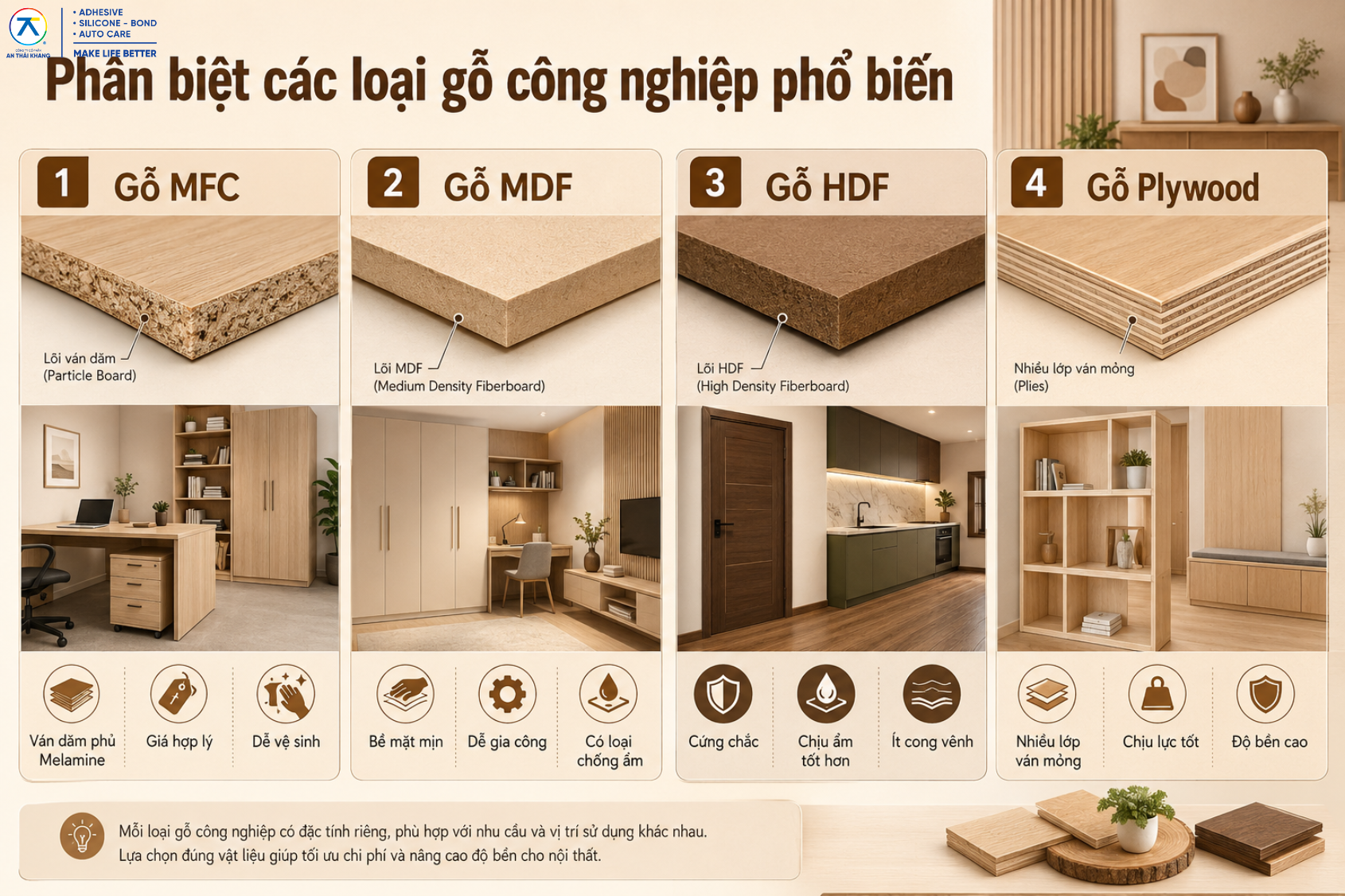
3.1. MFC Board
MFC is a melamine-faced particle board. Its core is made from small wood chips combined with adhesive, then pressed into boards and covered with a Melamine surface layer. MFC offers a wide range of colors and wood grain patterns, and its surface is relatively easy to clean.
MFC is commonly used for desks, filing cabinets, display shelves, wardrobes, beds, or furniture items that do not require complex shaping. The advantages of MFC are reasonable cost, fast installation, and consistent color. However, because its core is made from wood chips, the board edges need to be sealed carefully to reduce moisture penetration.
3.2. MDF Board
MDF stands for Medium-Density Fiberboard. It is made from fine wood fibers combined with adhesive and pressed into boards. MDF has a flat, smooth surface and is easier to process than MFC. It is one of the most commonly used boards in modern furniture production.
MDF is suitable for wardrobes, study desks, work desks, TV cabinets, decorative wall panels, engineered wood doors, and details that require painting or surface finishing with Melamine, Laminate, Acrylic, or Veneer. MDF is available in standard and moisture-resistant types. Moisture-resistant MDF is often preferred for kitchen cabinets, dry vanity areas, or spaces that require better stability.
3.3. HDF Board
HDF stands for High-Density Fiberboard. Compared with MDF, HDF has a higher compression density, so it is usually harder, stronger, and more moisture-resistant. This type of board is commonly used for engineered wood doors, wooden flooring, kitchen cabinets, or interior details that require higher durability.
The advantages of HDF include a smooth surface, high hardness, better screw-holding ability, and reduced warping when used under suitable conditions. However, HDF is usually more expensive than MFC and MDF, so users should consider both budget and actual usage needs before choosing it.
3.4. Plywood
Plywood is made from multiple thin layers of wood veneer stacked together and bonded with specialized adhesive. These layers are pressed together to form boards with good durability and load-bearing capacity.
Plywood is commonly used for cabinets, shelves, partitions, flooring, furniture requiring high durability, or details that need good load-bearing performance. Its disadvantage is that it is usually more expensive than some common engineered wood boards. In addition, its surface often needs to be treated or finished properly to achieve a higher aesthetic value.
4. Distinguishing Engineered Wood by Surface Finish
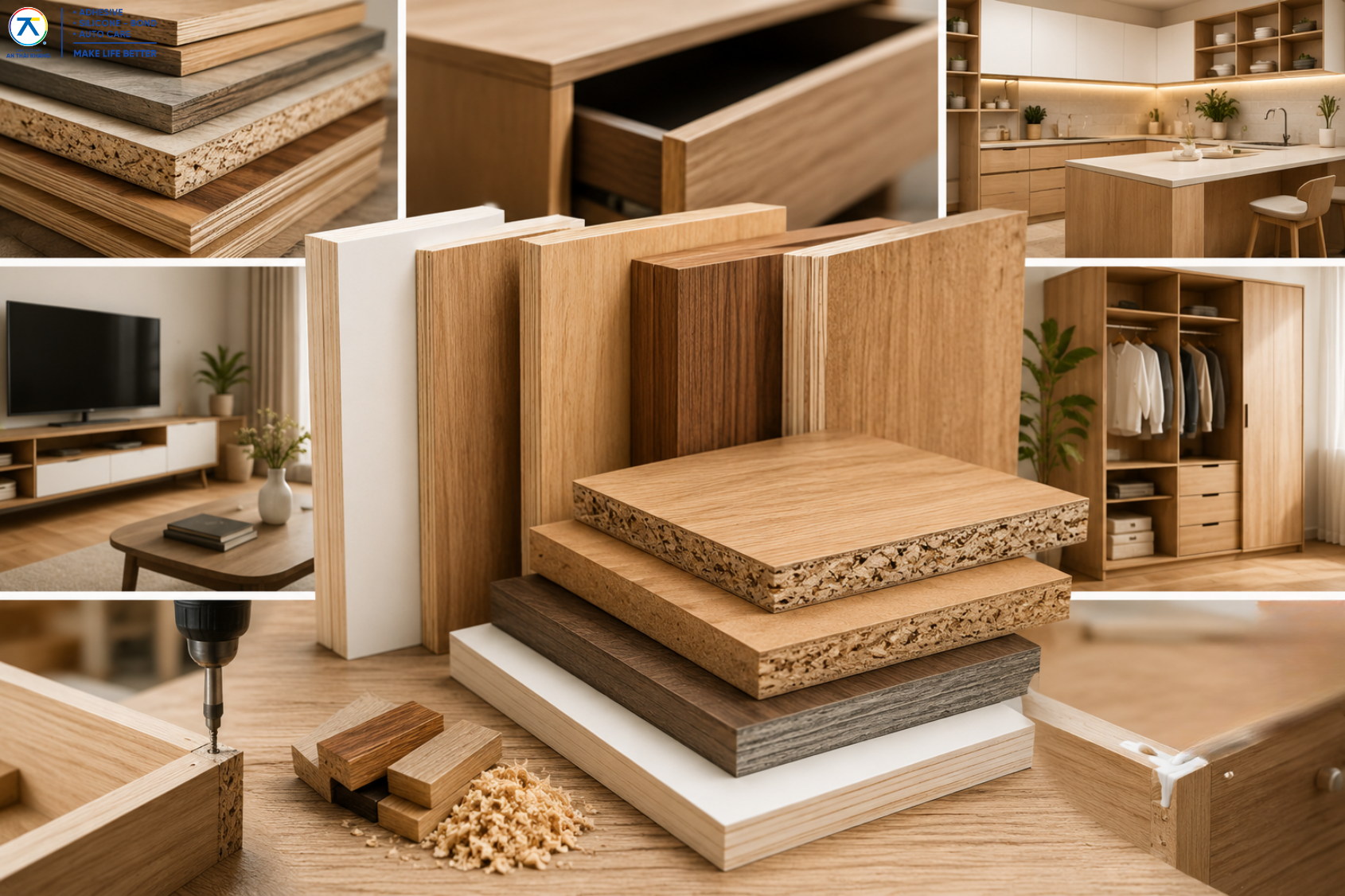
Besides the board core, the surface finish is also an important factor when distinguishing different types of engineered wood. The surface finish determines the color, gloss level, scratch resistance, ease of cleaning, and overall aesthetic style of the product.
Melamine: Commonly used on MFC and MDF, Melamine is available in many colors, wood grain patterns, stone patterns, and solid colors. It is suitable for desks, wardrobes, TV cabinets, filing cabinets, and general interior furniture.
Laminate: Laminate has better surface durability than Melamine. It is suitable for tabletops, kitchen cabinets, counters, office cabinets, or areas with frequent use.
Veneer: Veneer is a thin layer of natural wood bonded onto an engineered wood core. It creates a look that is close to natural wood and is suitable for high-end interiors or products that require real wood grain aesthetics.
Acrylic: Acrylic has a high-gloss surface, creating a modern and luxurious feel. It is commonly used for kitchen cabinets, wardrobes, display shelves, or spaces that require a glossy visual effect.
When working with surfaces such as veneer, laminate, or acrylic, it is important to pay attention to surface flatness and bonding quality. Spray adhesives can help create an even adhesive layer, improve the final surface finish, and reduce glue smearing or clumping.
5. Applications of Engineered Wood in Interior Design
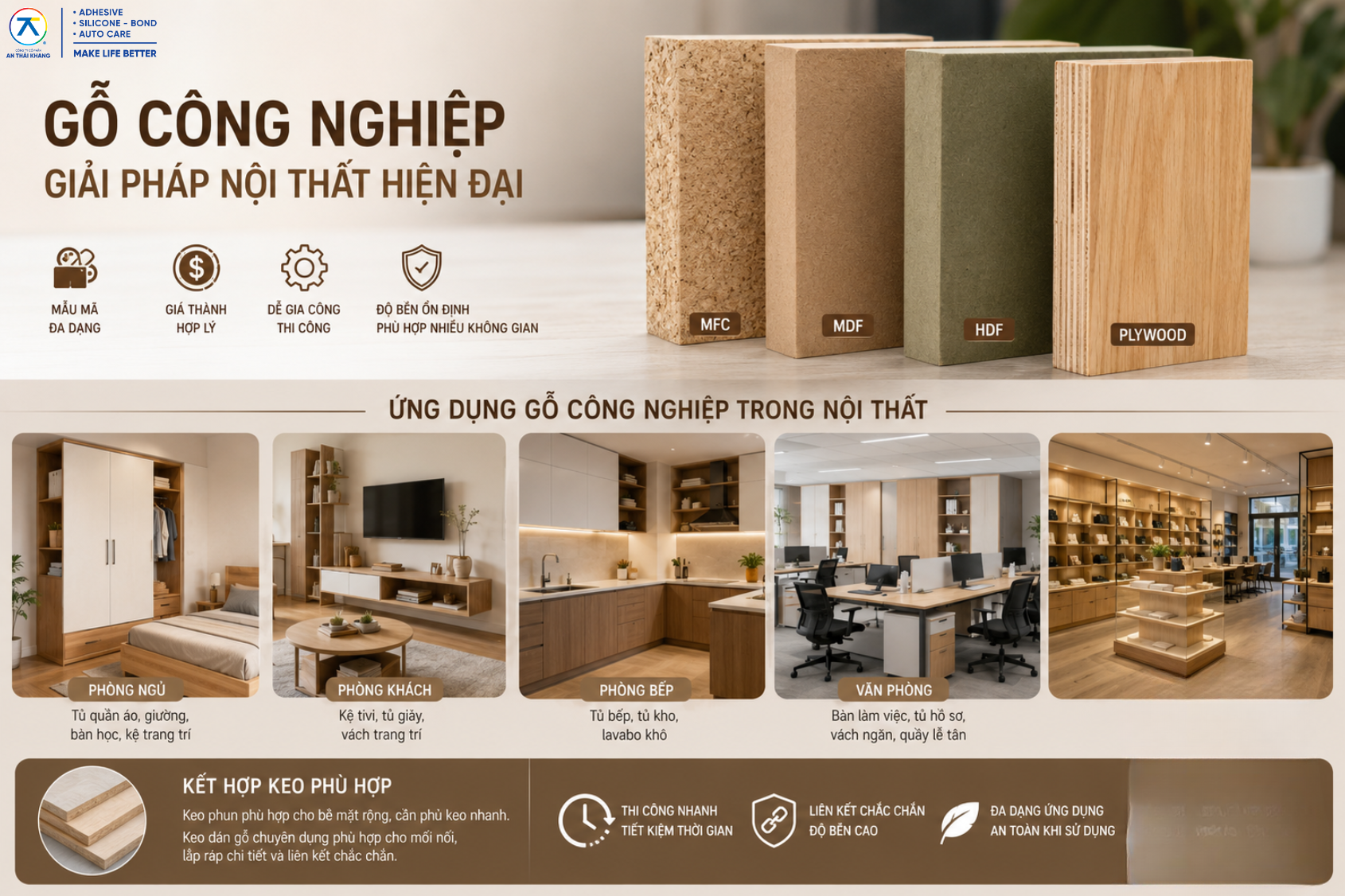
Engineered wood can be used in many interior applications, from homes to offices, shops, and production workshops. In residential spaces, this material is commonly used for wardrobes, beds, study desks, TV cabinets, shoe cabinets, decorative panels, kitchen cabinets, and storage systems.
In offices, engineered wood is used for work desks, filing cabinets, partitions, reception counters, and display shelves. MFC and MDF are often chosen for general applications because of their reasonable cost, easy processing, and wide variety of designs. HDF or plywood is more suitable for applications that require higher hardness, load-bearing strength, or stability.
In the production of sofas, chairs, beds, or products that combine foam, leather, fabric, synthetic leather, and wood boards, spray adhesive is commonly used because it helps apply adhesive quickly, evenly, and efficiently. For wood joints, connections, or furniture assembly, specialized wood glue helps create stronger and more stable bonds.
6. Suggested Interior Adhesives for Engineered Wood
When distinguishing different types of engineered wood, users often focus on the board core and surface finish but overlook the role of adhesive. In practice, adhesive directly affects joint strength, construction speed, and the final appearance of the finished product.
6.1. Keo Rồng Vàng P-66 for Various Interior Materials
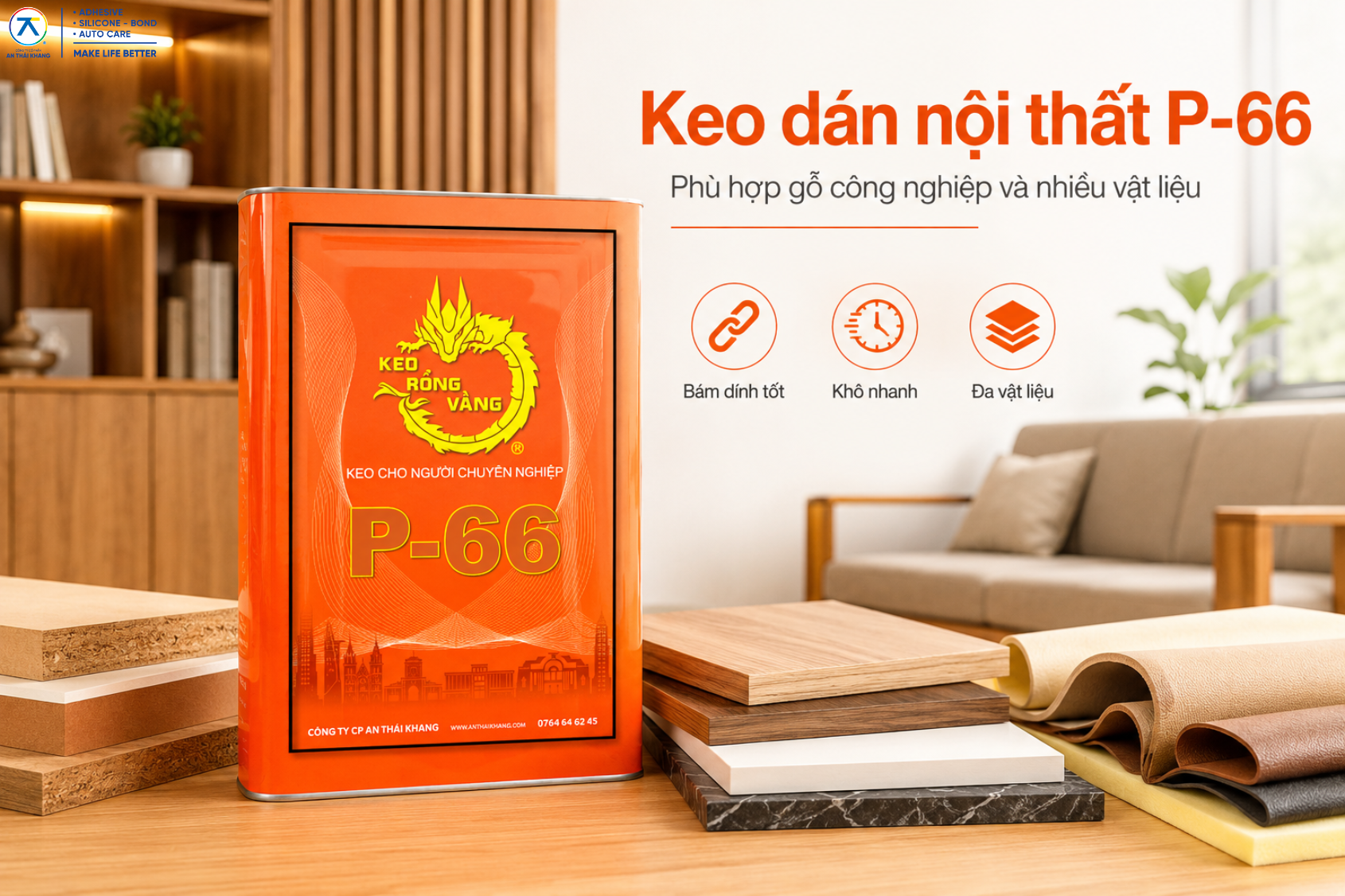
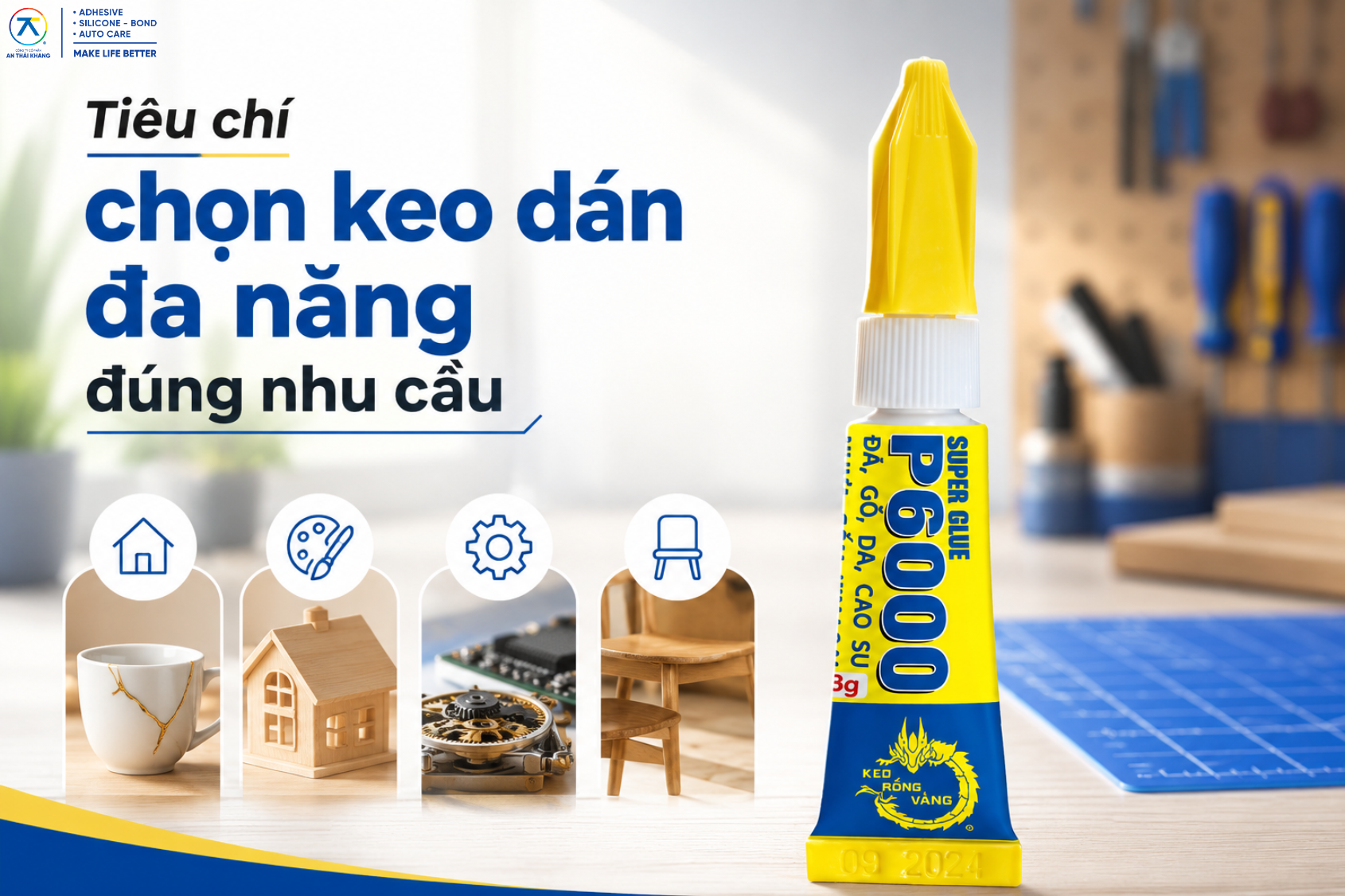
Keo Rồng Vàng P-66 is a solvent-based yellow adhesive with high elasticity, good bonding strength, and fast drying time. The product is suitable for many interior materials such as tables, chairs, sofas, cabinets, shelves, carpets, mica, MDF, plywood, decorative panels, synthetic leather, rubber, foam, and other surfaces that require flexible bonding.
For interior projects that involve bonding different materials, Keo Rồng Vàng P-66 is a convenient choice for installers, furniture workshops, repair units, or applications that require strong and durable bonding.
6.2. S-Bond Premium Wood Glue for Wood Joints
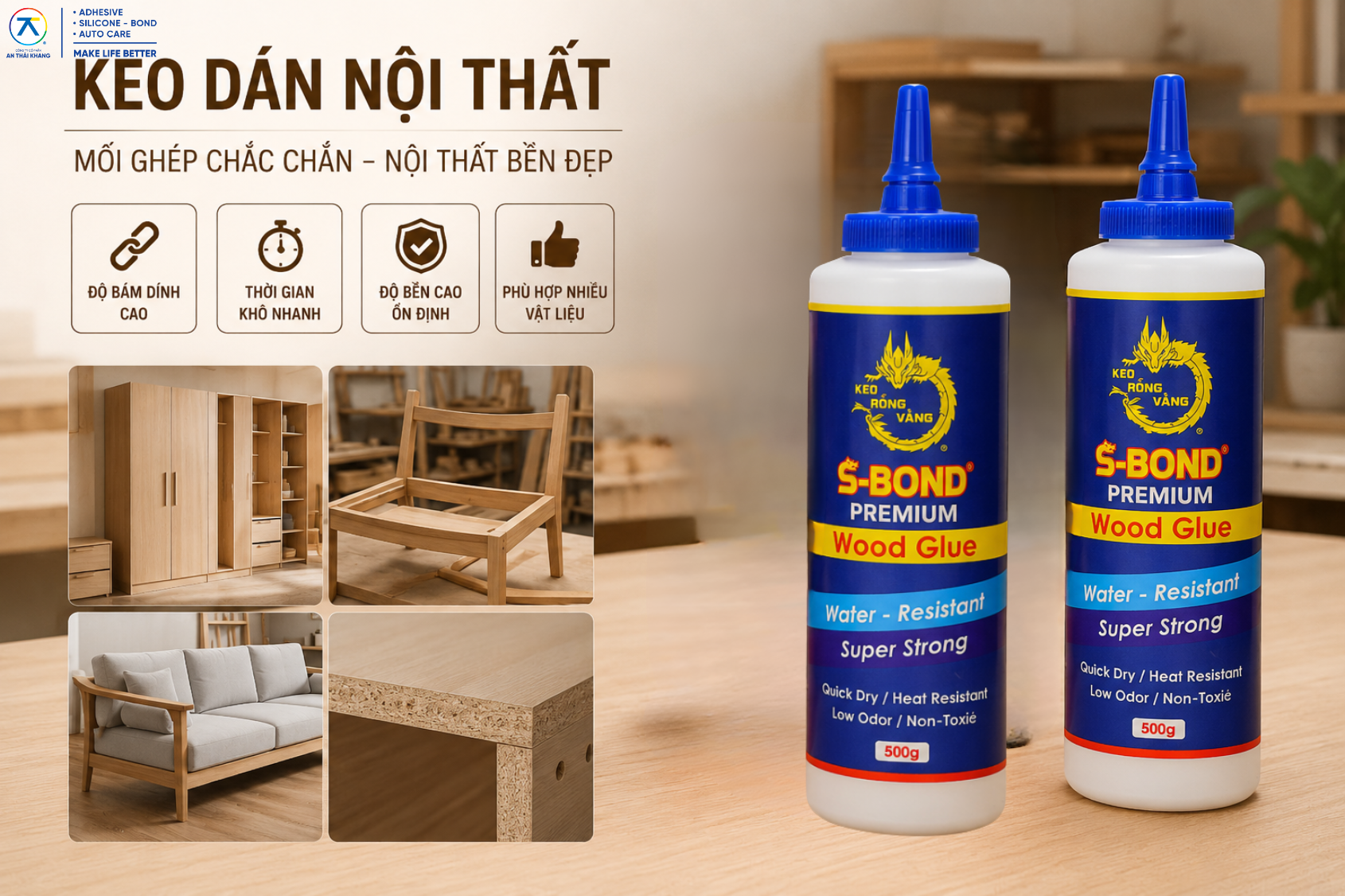
S-Bond Premium Wood Glue is a specialized adhesive for the woodworking industry. It is suitable for board joining, fixing joints, assembling tables, chairs, cabinets, and decorative wood details. The product offers high bonding strength, fast curing, heat resistance, and good chemical resistance.
For engineered wood products that require bonding between wood details, S-Bond Premium helps create stronger and more stable joints. It is suitable for furniture workshops, handicraft wood production, and applications that require a neat and well-finished result.
6.3. Spray Adhesives for Veneer, Laminate, MDF, and Sofa Production
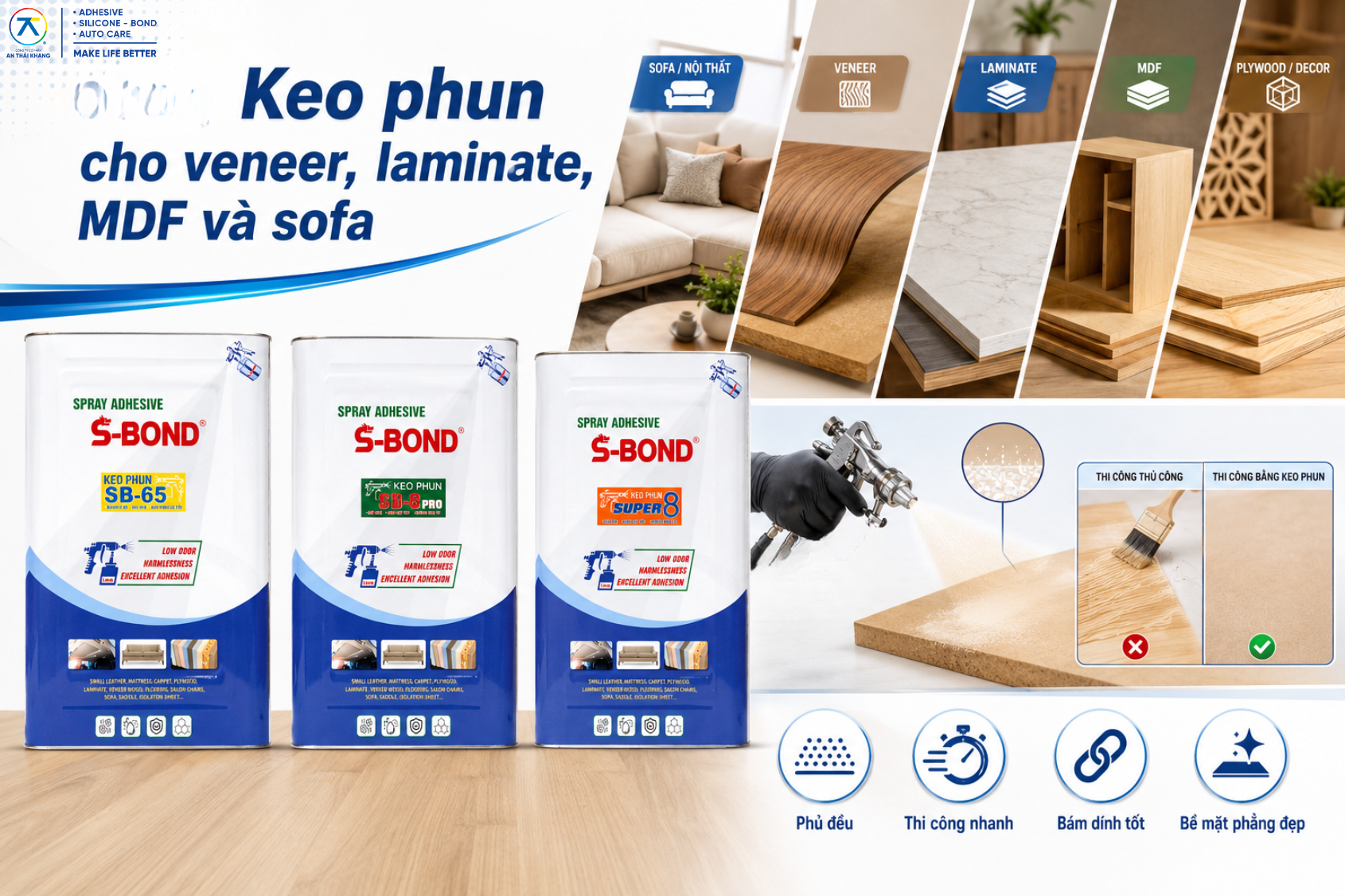
SB65 Spray Adhesive, SB8 Pro Spray Adhesive, and S-Bond Super 8 Spray Adhesive are suitable for applications that require fast construction speed and even adhesive coverage. These products can be used for sofas, veneer, laminate, MDF, plywood, carpets, foam, leather, fabric, and decorative interior materials.
For furniture manufacturing workshops, spray adhesives help shorten working time compared with manual brushing. Especially when bonding large surfaces or surface materials such as veneer and laminate, even spray application helps reduce glue smearing and clumping while creating a flatter and cleaner bonded surface.
7. Conclusion
Understanding how to distinguish different types of engineered wood helps users choose the right material for each interior application. MFC is suitable for products that require reasonable cost and fast construction. MDF has a smooth surface, is easy to process, and works well with many types of finishes. HDF has higher hardness and better stability, making it suitable for areas that require greater durability. Plywood offers good load-bearing capacity and is suitable for applications that require a strong structure.
However, to create durable and attractive interior products, choosing the right type of wood is not enough. It is also necessary to choose the right adhesive. For interior projects using engineered wood, Keo Rồng Vàng P-66 can be used for various materials, S-Bond Premium Wood Glue can be used for wood joints, and spray adhesives such as SB65, SB8 Pro, and S-Bond Super 8 can be used for sofas, veneer, laminate, MDF, plywood, and decorative materials.
When users understand the characteristics of each board type and use the right interior adhesive, the construction process becomes more stable, the bonds become stronger, and the finished product achieves a higher aesthetic value. This is an important foundation for creating engineered wood furniture that is durable, beautiful, and suitable for real-life use.
AN THAI KHANG JSC
- • Fanpage: An Thái Khang JSC
- • Hotline: 0764 644 245
- • Email: support@anthaikhang.com
- • Website: https://anthaikhang.com/