
What Is Shoe Adhesive? How to Choose Lasting Adhesive and Heat-Activated Adhesive
Learn how to choose and use lasting and heat-activated SU-BOND adhesives for footwear production.
Footwear is commonly made from multiple layers of materials, including leather, fabric, rubber, PU, PVC, EVA, and TPR. During use, these layers are continuously exposed to bending, pulling, friction, and environmental conditions. Therefore, the adhesive used to join the components must not only provide strong adhesion but also be compatible with the specific properties of each material.
Shoe adhesive is a specialised category of adhesive used for lasting, sole bonding, securing shoe uppers, and completing finished footwear products. Depending on the manufacturing process, users may choose either a lasting adhesive or a heat-activated adhesive to achieve the required bond strength and appearance.
An Thai Khang’s current range of solvent-based adhesives includes SU-BOND SB55, SB60, 405S, and 505S lasting adhesives, as well as SB68 and 3300S heat-activated adhesives developed for the footwear industry.
1. What Is Shoe Adhesive?
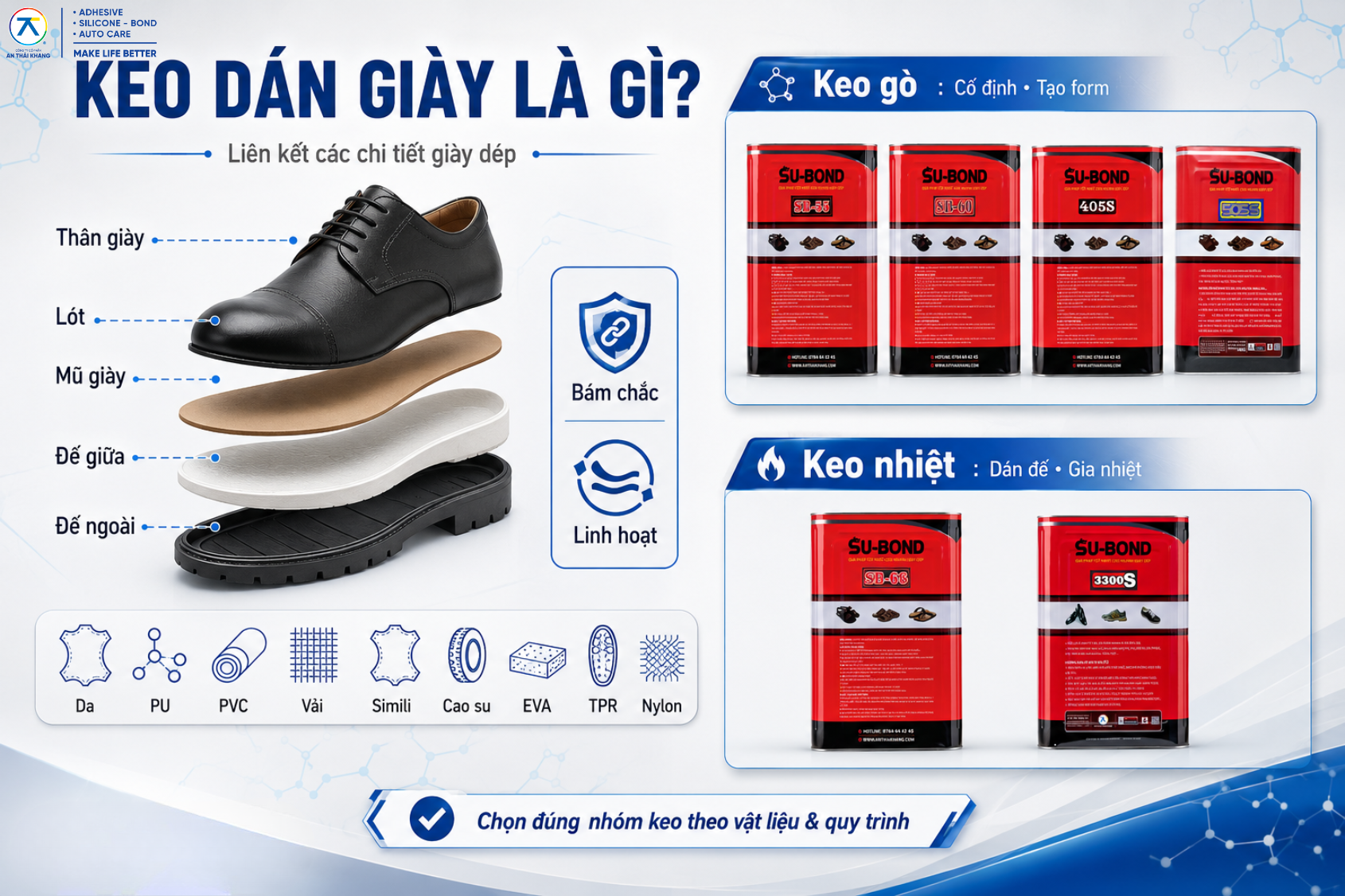
Shoe adhesive is specially developed to bond footwear components such as shoe uppers, linings, toe sections, midsoles, and outsoles. The adhesive must be compatible with materials commonly used in footwear manufacturing, including genuine leather, PU leather, PVC, fabric, synthetic leather, rubber, EVA, TPR, and nylon.
Unlike products that remain relatively stationary, footwear bends continuously as the wearer walks. The bonded joint must therefore be both strong and sufficiently flexible. If the adhesive layer is too brittle, incompatible with the material, or incorrectly applied, the shoe edges may open, the sole may separate from the upper, or individual components may peel away during use.
Within An Thai Khang’s product range, shoe adhesives are primarily divided into two categories:
Lasting adhesives: Used to secure components, form the shape of the shoe, and bond parts during the lasting or footwear assembly process.
Heat-activated adhesives: Require heat activation to develop adhesion and are commonly used in sole bonding and professional footwear manufacturing processes.
Each category has a different application method, waiting time, and suitable material range. Users should therefore not select an adhesive based solely on its initial tack or their usual application habits.
2. What Characteristics Should a Shoe Adhesive Have?
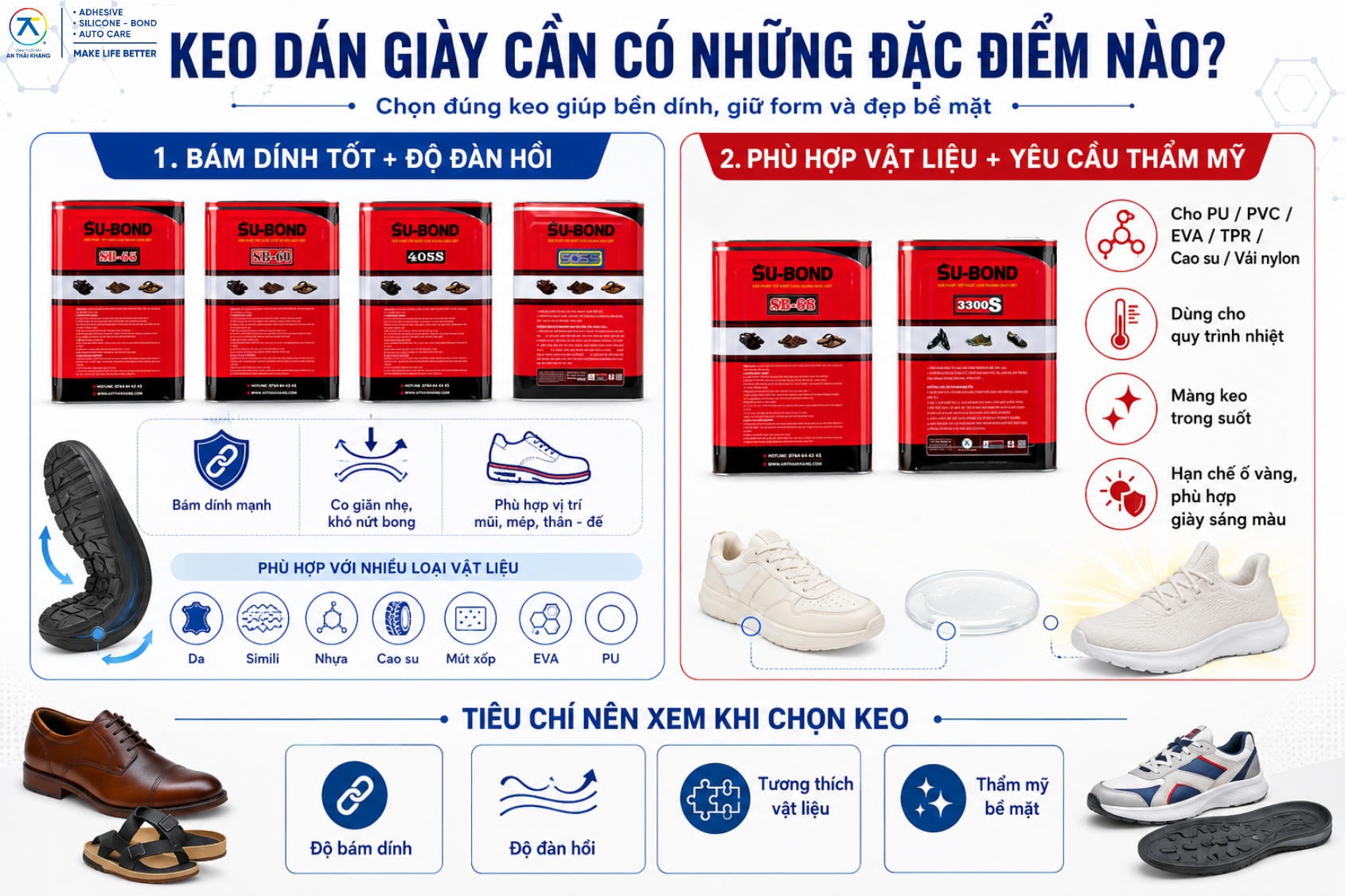
A suitable adhesive does more than simply join two surfaces. It also affects the durability, shape, and appearance of the finished product. When selecting an adhesive, users should consider the material, the manufacturing stage, and the conditions in which the footwear will be used.
2.1. Strong Adhesion with Sufficient Flexibility
Footwear is regularly exposed to pulling forces, friction, and repeated movement. The adhesive layer must therefore maintain its bond when the materials bend or undergo slight expansion and contraction.
SU-BOND SB55, SB60, 405S, and 505S are solvent-based yellow lasting adhesives that share two main characteristics: strong adhesion and continued flexibility after drying. They can be used on various materials, including leather, synthetic leather, plastic, rubber, foam, EVA, and PU.
Flexibility is particularly important around the toe, edges, and the joint between the shoe upper and the sole. These areas regularly change shape during movement. If the adhesive cannot withstand repeated flexing, the bonded joint may crack or gradually peel away from the outer edge.
2.2. Compatibility with Materials and Appearance Requirements
Not all types of footwear use the same materials. Leather shoes, sports shoes, canvas shoes, and sandals have different structures, so the most suitable adhesive may also vary.
For footwear made from leather, synthetic leather, fabric, or multiple material layers, solvent-based lasting adhesives are commonly considered. For PU, PVC, EVA, TPR, rubber, or nylon fabric surfaces that require a heat-bonding process, PU adhesives such as SB68 and 3300S may be more suitable.
Adhesive colour should also be considered. Lasting adhesives are usually light yellow or orange-yellow, while SB68 and 3300S heat-activated adhesives form a transparent adhesive film. These two heat-activated products are also presented as offering UV resistance and reduced yellowing, making them suitable for light-coloured footwear or products with high surface-finish requirements.
3. Should You Choose a Lasting Adhesive or a Heat-Activated Shoe Adhesive?
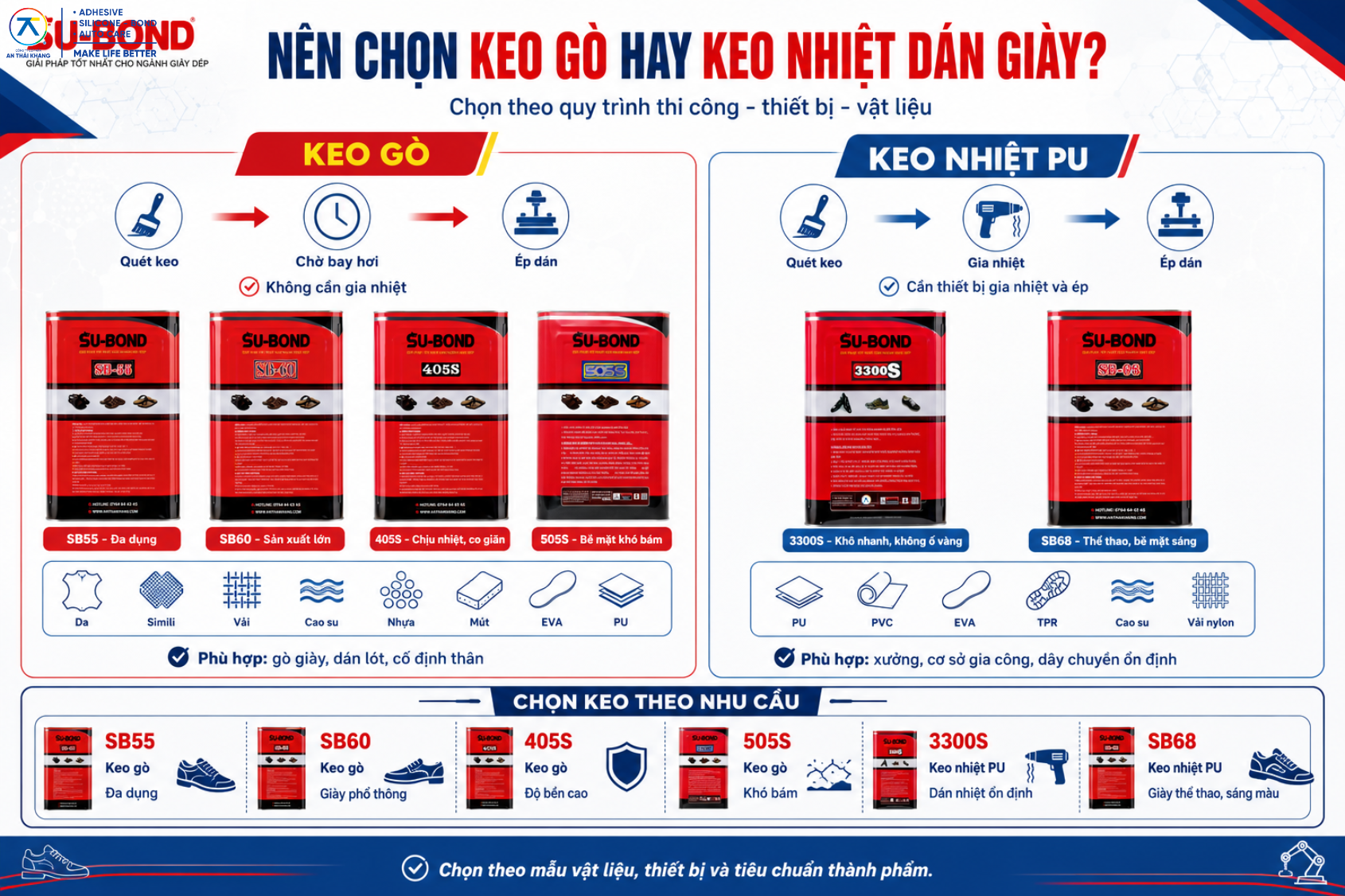
Lasting adhesives and heat-activated adhesives are both used in the footwear industry, but their application processes are different. The selection should be based on the manufacturing stage, available equipment, and the materials to be bonded.
3.1. Lasting Adhesives for Conventional Application Processes
Lasting adhesives are solvent-based yellow adhesives that can be applied directly to both surfaces. After allowing time for the solvent to evaporate, the components are pressed together to form the bond.
These products are suitable for shoe-lasting operations, securing uppers, bonding linings, and joining components made from leather, synthetic leather, fabric, rubber, plastic, foam, or EVA.
An Thai Khang currently offers four lasting adhesive products:
SU-BOND SB55: Suitable for leather, rubber, plastic, foam, synthetic leather, and various other materials.
SU-BOND SB60: Provides strong adhesion and good flexibility and is suitable for high-volume production requirements.
SU-BOND 405S: Notable for its heat resistance and ability to withstand material expansion and movement.
SU-BOND 505S: Suitable for PVC leather, PU, nylon, EVA, and other difficult-to-bond surfaces.
Unlike heat-activated adhesives, lasting adhesives do not require heat activation. However, users must still allow sufficient time for the solvent to evaporate before joining the two surfaces.
3.2. Heat-Activated Adhesives for Professional Manufacturing Processes
Heat-activated shoe adhesive must be activated with heat before the components are pressed together. This is the key difference between heat-activated adhesives and conventional lasting adhesives.
SU-BOND SB68 and 3300S are both solvent-based PU adhesives suitable for PU leather, PVC, EVA, rubber, TPR, genuine leather, and nylon fabric. Their transparent adhesive film helps minimise any effect on the colour of the bonded surfaces.
More specifically:
SU-BOND 3300S: Suitable for heat-bonding processes that require stable adhesion, fast drying, and a non-yellowing adhesive film.
SU-BOND SB68: Suitable for sports shoes, footwear accessories, and light-coloured products requiring flexibility and a high-quality appearance.
Because heat-activation and pressing equipment are required, these adhesives are more suitable for manufacturing workshops, footwear processing facilities, and production lines with established technical procedures.
3.3. Shoe Adhesive Selection Table
Product | Adhesive Category | Suitable Materials | Recommended Application |
|---|---|---|---|
SU-BOND SB55 | Lasting adhesive | Leather, synthetic leather, rubber, plastic, foam, EVA, and PU | Workshops requiring a versatile adhesive |
SU-BOND SB60 | Lasting adhesive | Leather, fabric, synthetic leather, rubber, and foam | Workshops requiring a versatile adhesive for large-scale production |
SU-BOND 405S | Lasting adhesive | Leather, plastic, EVA, foam, and flexible materials | Finished products requiring high durability |
SU-BOND 505S | Lasting adhesive | PVC, PU, nylon, EVA, and rubber | Difficult-to-bond surfaces |
SU-BOND 3300S | PU heat-activated adhesive | PU, PVC, EVA, TPR, rubber, and fabric | Stable heat-bonding processes |
SU-BOND SB68 | PU heat-activated adhesive | PU leather, PVC, EVA, rubber, and woven fabric | Sports shoes and light-coloured surfaces |
The information in this table has been compiled from the product range and individual product instructions. The final adhesive selection should still be based on the actual material samples, available equipment, production speed, and finished-product standards of each workshop.
You may also refer to the article “Which Adhesive Is Best for the Footwear Industry?” for more detailed information about the characteristics and suitable market segments of each SU-BOND product.
4. How to Use Shoe Adhesive Correctly
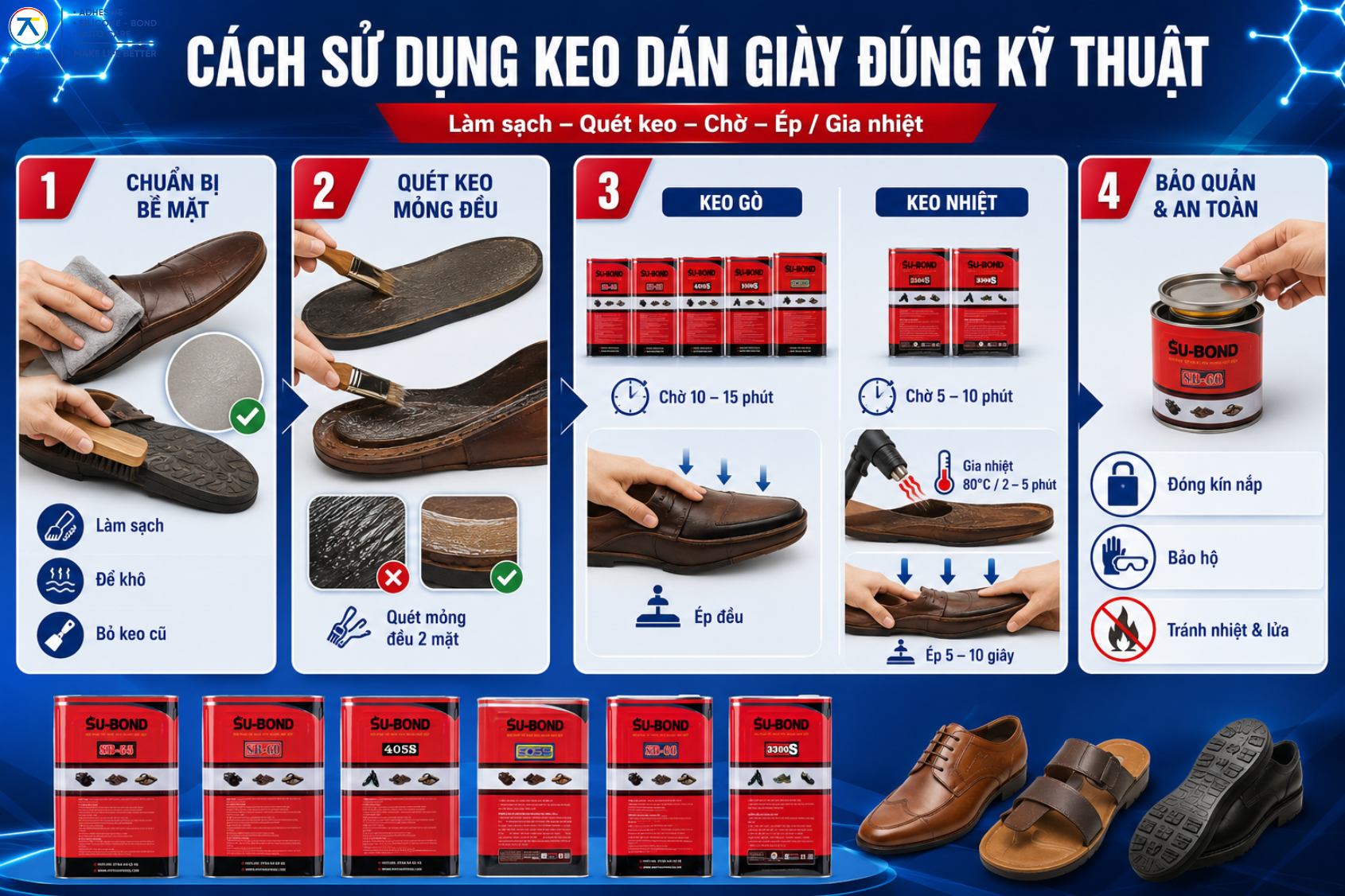
Selecting the right product is only the first step. The strength of the bonded joint also depends on surface preparation, the amount of adhesive applied, waiting time, and pressing force.
4.1. Prepare the Surfaces and Apply the Adhesive
Before application, remove dust, grease, old adhesive, and other contaminants from both surfaces. The materials must be dry before the adhesive is applied. If the old adhesive has formed lumps or is peeling, it should be carefully removed so that the new adhesive can make direct contact with the underlying material.
Next, apply a thin and even layer of adhesive to both surfaces. Avoid applying an excessively thick layer, as this may take longer to dry, spread beyond the bonding area, and reduce the appearance of the finished joint. However, an excessively thin layer may also fail to cover the entire contact area.
When working with a new product or material, test the adhesive on a small sample first. This helps evaluate adhesion, drying time, adhesive-film colour, and overall stability before the product is introduced into mass production.
4.2. Observe the Correct Waiting and Pressing Process
For SB55, SB60, 405S, and 505S lasting adhesives, wait approximately 10–15 minutes after application to allow the solvent to evaporate. Once the adhesive surfaces have become tacky and partially dry, align the two components correctly and apply even pressure to form the bond.
For SB68 and 3300S heat-activated adhesives, the process includes an additional heat-activation stage:
Clean the surfaces and allow them to dry.
Apply a thin layer of adhesive to both surfaces.
Wait approximately 5–10 minutes for the solvent to evaporate.
Heat the surfaces at approximately 80°C for two to five minutes.
Press the two surfaces firmly together for approximately five to ten seconds.
Keep the product stable before moving it to the next production stage.
Heat activation must be carried out using equipment suitable for the manufacturing process. Do not use a direct flame or apply the adhesive near an ignition source, as these products are solvent-based.
After use, close the container tightly to minimise solvent evaporation. Store the adhesive in a cool, dry, and well-ventilated area away from direct sunlight, high temperatures, and ignition sources. Operators should wear gloves, safety glasses, and other appropriate personal protective equipment.
For sole-bonding applications, you may also refer to the article “How to Create a Strong and Durable Shoe-Sole Bond with Specialised Adhesive” to learn about common problems such as sole separation, open edges, and important considerations during pressing and bonding.
5. Conclusion
Shoe adhesive should be selected according to the materials, application process, and finished-product requirements. Lasting adhesives are suitable for securing components, shaping footwear, and bonding various materials through an apply–wait–press process. Heat-activated adhesives, meanwhile, require thermal activation and are suitable for production lines working with PU, PVC, EVA, rubber, and other synthetic materials.
An Thai Khang’s SU-BOND range includes four lasting adhesives—SB55, SB60, 405S, and 505S—and two heat-activated adhesives—SB68 and 3300S. Each product has its own characteristics and suitable applications, allowing footwear manufacturers to select an adhesive according to their materials and production requirements.
To achieve a durable bond, users must clean the surfaces, apply an appropriate amount of adhesive, observe the correct waiting time, and apply even pressure. For new materials or orders with strict quality requirements, the adhesive should be tested on an actual sample before being used for mass production.
Customers can explore An Thai Khang’s complete range of shoe adhesives and solvent-based adhesives or contact the company for advice based on the type of footwear, materials, and actual manufacturing process.
AN THAI KHANG JSC
- • Fanpage: An Thái Khang JSC
- • Hotline: 0764 644 245
- • Email: support@anthaikhang.com
- • Website: https://anthaikhang.com/