
What Is Spray Adhesive? Applications, How to Choose, and Key Considerations
Spray adhesive is a fast, even, and cost-effective bonding solution for furniture manufacturing, sofas, foam materials, packaging, soundproofing materials, and many other industries.
In manufacturing industries where speed and consistency are essential, spray adhesive is becoming a popular choice thanks to its fast application, even coverage, and material-saving efficiency. Instead of manually applying adhesive with a brush or roller, the adhesive is sprayed directly onto the material surface in a thin layer, creating a cleaner and more uniform bond.
Spray adhesive is especially suitable for large surfaces, soft materials, or products that require multi-layer bonding, such as sponge foam, foam, fabric, synthetic leather, felt, paper, cardboard, engineered wood, acoustic materials, and thermal insulation materials. However, to achieve the best results, users need to choose the right adhesive based on the material, application process, and actual usage requirements.
1. What Is Spray Adhesive?
Spray adhesive is a type of adhesive designed to be applied by spraying it onto the surface of materials. During application, the adhesive is dispersed into a thin and even layer, allowing it to cover large areas in a short amount of time.
Depending on the application needs, spray adhesive may come in the form of handheld aerosol cans, canisters used with spray guns, or large drums for industrial spray systems. The main advantage of spray adhesive is that it creates a thin bonding layer while still ensuring the required adhesion. As a result, the product bonds firmly without becoming bulky, showing adhesive marks, or absorbing too much adhesive.
1.1. Key Differences of Spray Adhesive
Compared with conventional brush-on adhesives, spray adhesive offers faster application speed and more even coverage. When bonding large surfaces, brush-on adhesive can easily result in uneven thickness, which affects both bond strength and the appearance of the finished joint.
Spray adhesive allows better control over adhesive consumption, especially in mass production. Operators can adjust the spray distance, adhesive output, and coverage according to each specific material.
1.2. Materials Suitable for Spray Adhesive
Spray adhesive is commonly used for sponge foam, foam, fabric, leather, faux leather, felt, rubber, paper, cardboard, plywood, MDF boards, acoustic panels, and thermal insulation materials. For difficult-to-bond surfaces such as PP plastic, PE plastic, smooth metal, or oil-coated materials, testing should be carried out before mass production.
2. Why Use Spray Adhesive in Manufacturing?
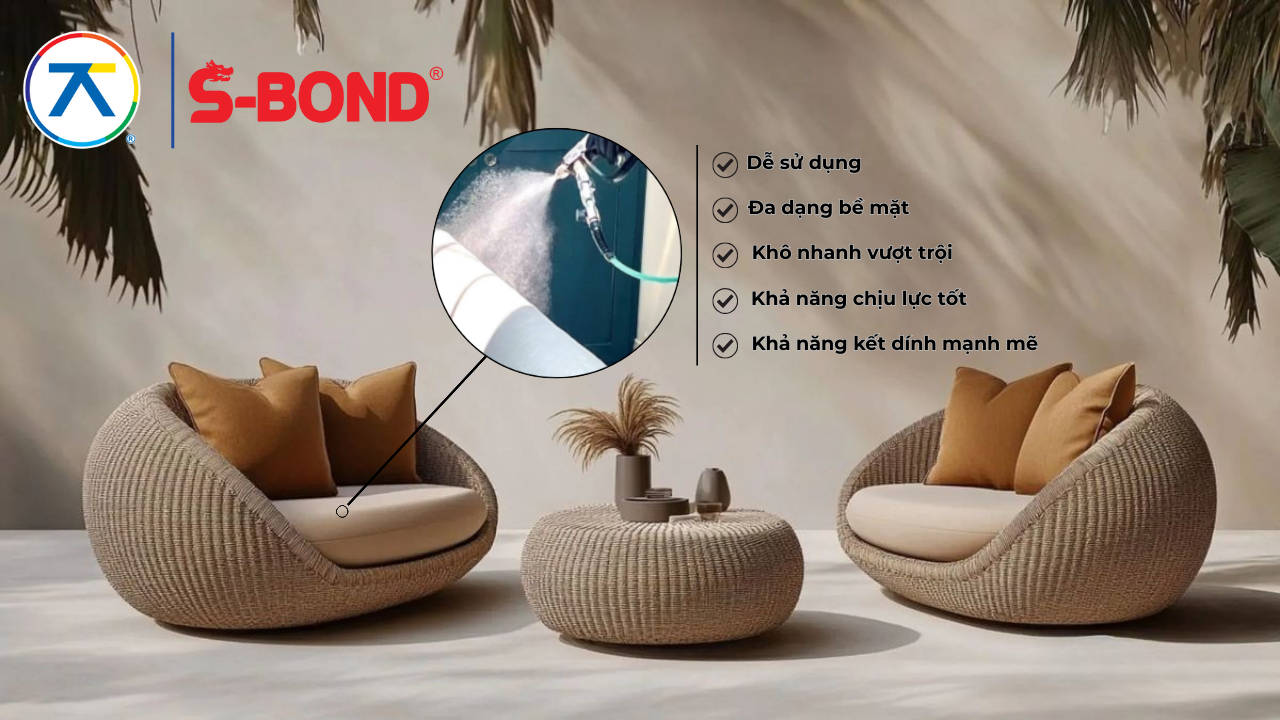
Spray adhesive not only enables fast bonding but also helps businesses control costs more effectively. In manufacturing, a suitable adhesive must meet three key requirements: speed, bond strength, and application stability in large-scale production.
2.1. Faster Application Speed
For large surfaces, spray application significantly shortens working time. Workers do not need to apply adhesive repeatedly, yet they can still achieve even coverage across the entire surface. This is highly beneficial in the production of sofas, cushioned chairs, floor mats, acoustic partitions, packaging, and interior materials.
2.2. Reduced Adhesive Waste
When sprayed with the correct technique, the adhesive is distributed evenly and in the right amount. This helps prevent over-application, adhesive dripping, or overly thick adhesive layers. For manufacturers that use adhesive regularly, reducing adhesive waste can significantly optimize costs.
2.3. Improved Aesthetic Finish
A high-quality bond requires a clean, thin adhesive layer that does not deform the material surface. Spray adhesive helps minimize brush marks, raised adhesive areas, adhesive bleed-through, and material wrinkling. This is an important factor for products that require a high-quality finish, such as sofas, furniture, fabric-covered panels, and decorative materials.
3. Common Types of Spray Adhesive
Currently, An Thái Khang’s S-Bond spray adhesive range includes notable products such as SB65 Spray Adhesive, SB8 Pro Spray Adhesive, and S-Bond Super 8 Spray Adhesive. These spray adhesives are specially designed for furniture manufacturing, sofas, engineered wood, laminate, veneer, floor carpets, and decorative materials.
Each adhesive line has its own strengths and is suitable for different application needs. When choosing a product, users should consider the materials to be bonded, production scale, adhesion requirements, and actual working conditions.
Spray Adhesive Line | Key Features | Suitable Applications | Recommended For |
|---|---|---|---|
SB65 Spray Adhesive | Easy to apply, good adhesion, helps create an even adhesive layer on material surfaces | Sofas, veneer, laminate, MDF, floor carpets, plywood, engineered wood, decorative materials | Workshops that need a stable, easy-to-use adhesive with versatile applications |
SB8 Pro Spray Adhesive | High adhesion, even spray layer, suitable for products requiring a clean finished surface | Sofas, beds, cabinets, tables, laminate, MDF, plywood, veneer, floor carpets, flooring boards, foam, leather, fabric | Furniture production requiring strong bonds and high aesthetic quality |
S-Bond Super 8 Spray Adhesive | Good bonding performance, easy application, supports even coverage on various materials | Sponge foam, leather, wood, veneer, laminate, MDF, sofas, carpets, flooring boards, decorative materials | Fast and flexible application needs that require even coverage |
4. Practical Applications of Spray Adhesive
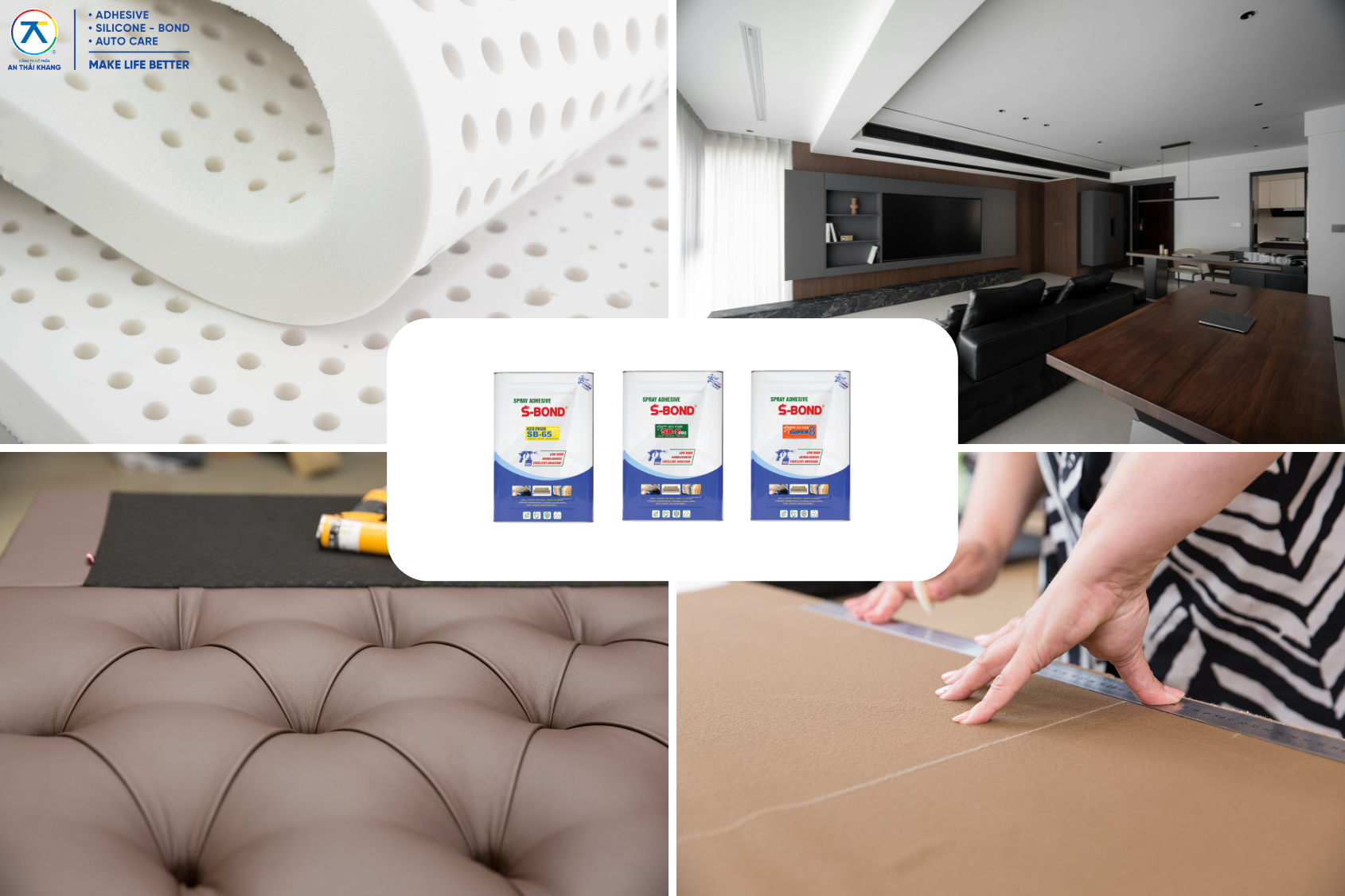
Spray adhesive is widely used in many industries because it meets the demand for fast bonding, even coverage, and flexibility across various materials.
4.1. Sofa, Mattress, and Foam Industry
In the production of sofas, office chairs, back cushions, seat cushions, and molded foam products, spray adhesive is commonly used to bond foam to foam, foam to fabric, foam to leather, or foam to supporting frames.
For this group of materials, the adhesive needs to provide good adhesion without hardening, corroding, or deforming the foam. This is why users should choose spray adhesives specifically designed for sponge foam and foam materials.
4.2. Furniture and Decorative Materials Industry
Spray adhesive is used to bond felt fabric, synthetic leather, covering panels, lining materials, decorative surface layers, and acoustic panels. Its major advantage is that it helps create a cleaner finished surface, minimizes visible adhesive marks, and reduces edge wrinkling.
4.3. Packaging, Paper, and Cardboard Industry
In the packaging industry, spray adhesive helps quickly bond paper, cardboard, lining layers, advertising models, and display materials. For paper-based materials, the amount of adhesive must be carefully controlled to prevent warping, wrinkling, or excessive adhesive absorption.
5. How to Choose the Right Spray Adhesive
Choosing the right spray adhesive directly affects bond durability, production speed, and the defect rate of finished products. Users should not choose adhesive based solely on the lowest price, but should evaluate its actual performance in real production conditions.
5.1. Identify the Materials to Be Bonded
Before choosing an adhesive, it is necessary to clearly identify the material combination to be bonded. For example: foam to foam, fabric to foam, leather to wood, paper to cardboard, or foam to metal. Each material has different levels of absorbency, surface roughness, and elasticity, so it requires a compatible adhesive.
5.2. Check the Drying Time
Drying time directly affects production flow. If the adhesive dries too slowly, it will slow down the production line. If it dries too quickly, workers may have difficulty aligning the materials. A good adhesive should have a workable open time that suits the actual conditions of the workshop.
5.3. Evaluate Adhesion and Durability
Users should not only check tackiness immediately after spraying. It is also necessary to evaluate peel strength after the adhesive has fully dried, as well as durability under heat, load, humidity, or bending. For products requiring high stability, sample testing before mass production is a mandatory step.
6. How to Use Spray Adhesive Correctly
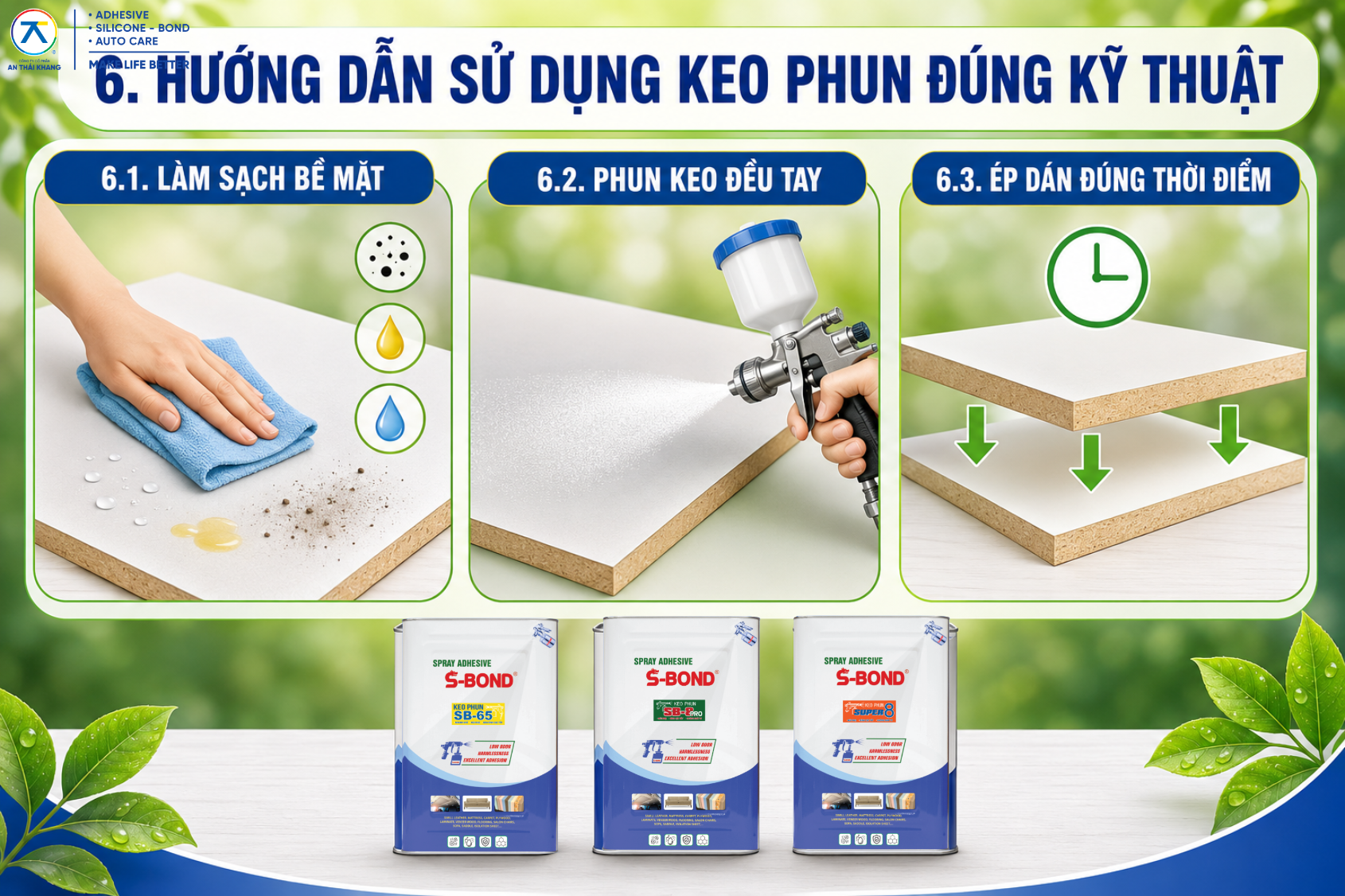
Spray adhesive only performs well when applied properly. Mistakes in surface preparation, spray distance, or bonding timing can all weaken the bond.
6.1. Clean the Surface
The surface must be clean, dry, and free from dust, oil, water, or impurities. If the adhesive bonds to a layer of dust instead of the actual material, the bond can easily peel off after a period of use.
6.2. Spray Evenly
When spraying, maintain a stable distance and move the hand evenly. Spraying too close can cause adhesive buildup, while spraying too far can cause the adhesive to disperse into the air and lead to waste. In mass production, the application process should be standardized to ensure consistent quality across products.
6.3. Press the Materials at the Right Time
Some adhesives require a short waiting time for the surface to become tacky before pressing the materials together. If the materials are pressed too early, the bond may slip or take longer to stabilize. If left too long, the adhesive may lose tack. After joining the two surfaces, sufficient pressure should be applied to increase contact area and strengthen the bond.
7. Common Mistakes and Final Notes When Using Spray Adhesive
Although spray adhesive is easy to use, small mistakes during application can still reduce the quality of finished products.
7.1. Applying Too Much Adhesive
Applying more adhesive does not mean achieving a stronger bond. An overly thick adhesive layer can make the product dry slowly, create raised areas, cause adhesive bleed-through, or deform the surface. The correct method is to spray a thin, even layer with just the right amount of adhesive.
7.2. Not Testing the Adhesive Before Production
Each workshop has different materials, temperature, humidity, equipment, and operating methods. Therefore, an adhesive that works well in one place may not necessarily be suitable in another. Before using it in large quantities, testing should be carried out on actual materials and bond strength should be checked after the adhesive has dried.
8. Conclusion
Spray adhesive is an effective bonding solution for industries that require fast application, even coverage, and cost optimization. This product is especially suitable for sponge foam, foam, fabric, synthetic leather, furniture, packaging, and acoustic and thermal insulation materials.
To use spray adhesive effectively, users need to choose the right adhesive for the material, control the spray amount, properly clean the surface, and conduct thorough testing before mass production. A suitable adhesive not only makes the bond stronger but also helps stabilize the production process, reduce defects, and save long-term costs.
AN THAI KHANG JSC
- • Fanpage: An Thái Khang JSC
- • Hotline: 0764 644 245
- • Email: support@anthaikhang.com
- • Website: https://anthaikhang.com/