
How to Use Expanding Foam to Seal Gaps Around Doors
Expanding foam helps fill gaps around doors, improves airtightness, supports sound and thermal insulation, and reduces vibration. Learn a simple DIY method for using expanding foam at home.
Gaps around doors are a fairly common issue after installing new doors, renovating a house, or using the doors for a long time. Small openings between the door frame and the wall can allow dust, wind, noise, or heat to enter the room, making the space less airtight and less visually appealing. For these areas, expanding foam is a simple DIY solution that is easy to apply and suitable for household users.
Expanding foam is a one-component polyurethane foam that expands when exposed to air or moisture. Once dry, the foam forms a lightweight yet firm structure that helps fill empty spaces, supports sound insulation, thermal insulation, vibration reduction, and improves airtightness around doors. RV FOAM Expanding Foam, S-FOAM 900g, and S-FOAM NEO 750ml are all designed to fill gaps, seal joints, provide sound and thermal insulation, and can be used flexibly with either an applicator tube or a dedicated foam gun.
1. What is expanding foam and why is it suitable for sealing gaps around doors?

Expanding foam is an aerosol product that creates foam when sprayed and continues to expand to fill empty spaces. Thanks to this property, it is highly suitable for uneven gaps, deep gaps, or openings that are difficult to treat with conventional sealing materials.
Around doors, expanding foam helps seal gaps between the door frame and the wall, gaps around windows, room doors, bathroom doors, balcony doors, or areas that need better airtightness. After curing, any excess foam can be trimmed to create a neater surface before painting, applying filler, or completing decorative finishing.
1.1. Benefits of using expanding foam around doors
Expanding foam has good filling ability, helping seal small to medium-sized gaps. When applied correctly, the foam layer can reduce drafts, limit dust from entering through door gaps, and help reduce outside noise.
The product is also suitable for many common construction surfaces such as concrete, brick, wood, aluminum, steel, PVC, or glass, depending on the product line. For example, S-FOAM NEO can adhere to many surfaces such as PVC, brick, concrete, glass, wood, steel, and aluminum; S-FOAM 900g adheres to brick, glass, steel, aluminum, wood, and PVC.
1.2. When should you use expanding foam?
You can use expanding foam when you notice gaps around doors, uneven wall areas next to the door frame, drafts coming through the door, rooms that are easily affected by noise, or empty spaces that need to be sealed quickly after installation. This is a suitable option for DIY work at home because the process is not too complicated, as long as you prepare the right tools and follow each step properly.
2. Tools to prepare before applying expanding foam

Before starting, you should prepare all necessary tools to make the application process cleaner and more efficient. For DIY users, careful preparation helps reduce common issues such as applying too much foam, smearing foam onto the door frame, or having difficulty handling excess foam after it dries.
The tools you need include an expanding foam can, the included applicator tube or a dedicated foam gun, gloves, safety glasses, a utility knife, cleaning cloth, masking tape, and a suitable cleaning solution. If the gaps around the door are in areas that easily collect dust, you should also prepare a small brush or a mini vacuum cleaner to clean the surface before spraying.
2.1. Choose the right type of expanding foam
For sealing gaps around doors at home, you can choose expanding foam products that expand quickly, adhere well, and are easy to apply. RV FOAM Expanding Foam is suitable for installing windows and doors, filling gaps, providing sound insulation, thermal insulation, and vibration reduction. The product comes in a 750ml size and can be used with either a foam gun or an applicator tube.
S-FOAM 900g Expanding Foam is suitable for jobs that require a larger amount of foam. It can be used to fill gaps, seal joints, and provide sound and thermal insulation for windows, water pipes, wall partitions, and other areas in civil construction projects.
S-FOAM NEO 750ml Expanding Foam is a flexible option for both professional workers and household users. It expands quickly, dries fast, adheres well, and can be used with either a foam gun or the included applicator tube.
2.2. Clean the gap area
The surface around the gap should be cleaned of dust, grease, loose mortar, or peeling paint. If the gap is still dirty, the foam may not adhere evenly, may form hollow areas, or may reduce airtightness after finishing.
You should use a dry cloth or a small brush to clean the gap. For deep gaps, you can vacuum the dust first and then check the area again by hand. Do not apply the foam on surfaces that are flooded with water or excessively wet.
3. How to use expanding foam to seal gaps around doors

Once the surface has been prepared, you can start applying the expanding foam. The most important rule is not to fill the entire gap from the beginning, because the foam will continue to expand after it leaves the can. These expanding foam products are recommended to be sprayed to fill about 50% of the gap volume, then left to expand and fill the remaining space on their own.
3.1. Step 1: Protect the door edges with masking tape
Before spraying, apply masking tape along the edges of the door frame and the surrounding wall. This step helps prevent the foam from smearing onto the door surface, especially on wooden doors, aluminum-glass doors, or areas that have already been painted and finished.
If you are applying foam to vertical gaps on both sides of the door, you should also cover the floor area below to prevent foam from falling onto the surface. Fresh foam is easier to clean, but once it has dried, it will need to be removed mechanically.
3.2. Step 2: Shake the can well before use
Shake the can well for at least 40 seconds before use. This helps mix the components inside evenly, allowing the foam to spray more consistently and reducing uneven foam formation.
After shaking, attach the applicator tube or foam gun to the top of the can. For small gaps around doors, the included applicator tube can work well. For long gaps, deep gaps, or situations where more precise foam control is needed, a foam gun will help you apply the product more evenly.
3.3. Step 3: Spray the foam from bottom to top
Place the applicator tip close to the gap, hold the can in the correct position, and spray from bottom to top. This method helps the foam adhere evenly, reduces hollow spaces inside the gap, and allows the gap to be filled more firmly.
Do not spray too quickly or fill 100% of the gap. You only need to fill about half of the gap volume, then wait for the foam to expand. If the gap is too deep, apply the foam in thin layers instead of trying to spray one thick layer at once.
4. Finish the surface after the expanding foam dries

After spraying, the foam will begin to expand and cure. Depending on the product line, the surface drying time may vary. RV FOAM has a drying time of about 6–15 minutes, S-FOAM 900g becomes surface-dry in about 10–15 minutes, while S-FOAM NEO becomes tack-free after about 20–25 minutes.
Once the foam has stabilized, use a utility knife to cut away any excess foam protruding from the door edge. Cut slowly along the plane of the wall or door frame to keep the surface neat and avoid creating deep dents. After that, you can apply putty, paint over the surface, or use decorative trim depending on your finishing needs.
4.1. How to handle excess foam
If the foam is still fresh, it can be cleaned with acetone or a specialized cleaning solution. If the foam has already dried, it must be removed by cutting, scraping, or mechanical sanding. Therefore, when doing DIY work at home, you should wipe away any smeared foam as soon as possible to avoid letting it harden on the door surface.
4.2. Is it necessary to paint over the foam after trimming?
For exposed areas, you should paint over the foam, apply filler, or cover it with trim to improve the appearance. After being cut, the foam surface is porous. If left exposed for a long time, it can collect dust and make the area around the door look unfinished.
5. Common mistakes when using expanding foam around doors
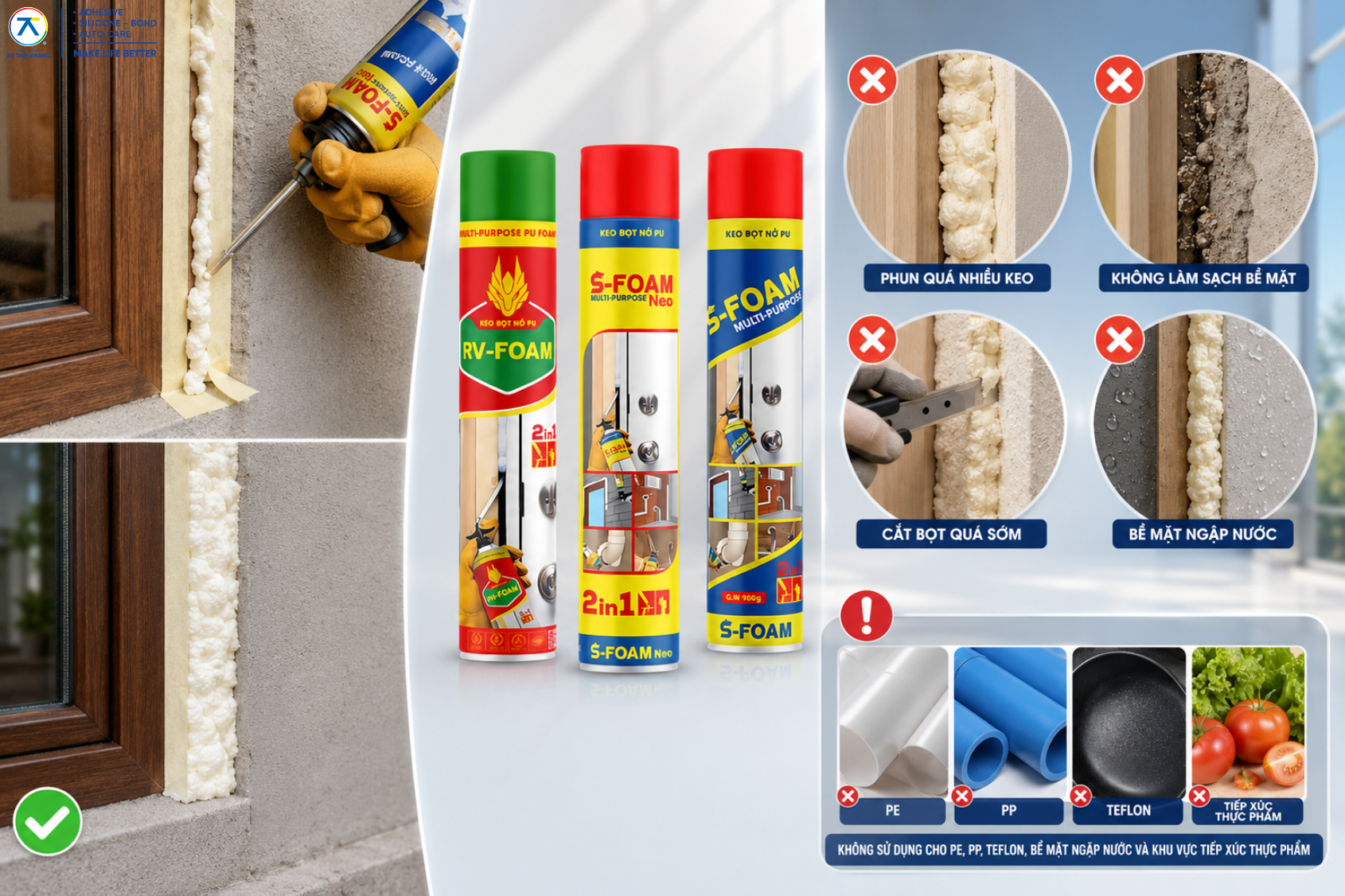
A common mistake is spraying too much foam from the beginning. Because expanding foam continues to expand, filling the gap completely can cause the foam to overflow, stain the door frame, and take more time to remove.
The second mistake is not cleaning the surface before application. Dust, grease, or loose mortar can reduce adhesion, making the filled area less secure and more likely to open up again after a period of use.
The third mistake is cutting the foam too early. If the foam inside has not stabilized, early trimming can cause the surface to collapse, become hollow, or look uneven. You should wait until the foam is sufficiently dry before trimming.
In addition, expanding foam should not be used on unsuitable surfaces such as PE, PP, Teflon, flooded surfaces, or areas that come into direct contact with food. The expanding foam products mentioned above also include a warning not to use them on PE, PP, Teflon, flooded surfaces, or food-contact areas.
6. Safety notes and storage instructions after use

When using expanding foam, you should wear gloves, safety glasses, and a mask or protective respirator. Do not smoke, and do not apply the product near high heat sources or open flames. If the foam gets on your skin, wash it off with water and soap. If it gets into your eyes, rinse immediately with clean water and seek medical attention.
The suitable application temperature for these expanding foam products is from +5°C to +45°C. For storage, keep the product in a dry, cool, and well-ventilated place, away from direct sunlight, heat sources, or flames. The suitable storage temperature is about 5–27°C, with humidity between 30–70%.
If you only use part of the can, close the cap carefully after use and limit the product’s exposure to air for too long. For foam guns, clean the gun tip after application to prevent dried foam from clogging the tool.
7. Conclusion
Expanding foam is a convenient DIY solution for sealing gaps around doors. It helps make the door frame area more airtight, supports sound insulation and thermal insulation, reduces vibration, and improves the finished appearance. By cleaning the surface, shaking the can well, spraying about 50% of the gap volume, and trimming the excess foam after it dries, you can quickly fix gaps around doors at home.
For different needs, you can consider RV FOAM Expanding Foam, S-FOAM 900g Expanding Foam, or S-FOAM NEO 750ml Expanding Foam. All three product lines are suitable for filling gaps, sealing joints, providing sound and thermal insulation, and supporting application in civil construction projects.
AN THAI KHANG JSC
- • Fanpage: An Thái Khang JSC
- • Hotline: 0764 644 245
- • Email: support@anthaikhang.com
- • Website: https://anthaikhang.com/