
Neat and Professional Interior Repairs with SIL AC Sealant
A guide to repairing interior surfaces and sealing wall cracks, ceiling gaps, door-frame joints, and plasterboard joints using SIL AC acrylic-based sealant, which is easy to apply and can be painted over.
During use, small cracks and gaps may appear in walls, ceilings, door frames, or decorative interior elements. Although these defects are generally not serious, they can make a space look old, inconsistent, and aesthetically unappealing.
Instead of dismantling or replacing an entire component, individual areas can be repaired using an appropriate sealing and filling method. This approach saves time, minimizes dust, and reduces the amount of work required during renovation.
For dry indoor joints that need to be painted after completion, SIL AC Sealant is a suitable option to consider. It is a water-based acrylic sealant designed for filling, crack treatment, and interior repair applications. The product can be applied to various construction materials and painted over after it has fully cured.
1. Why Should Interior Cracks and Gaps Be Repaired Early?
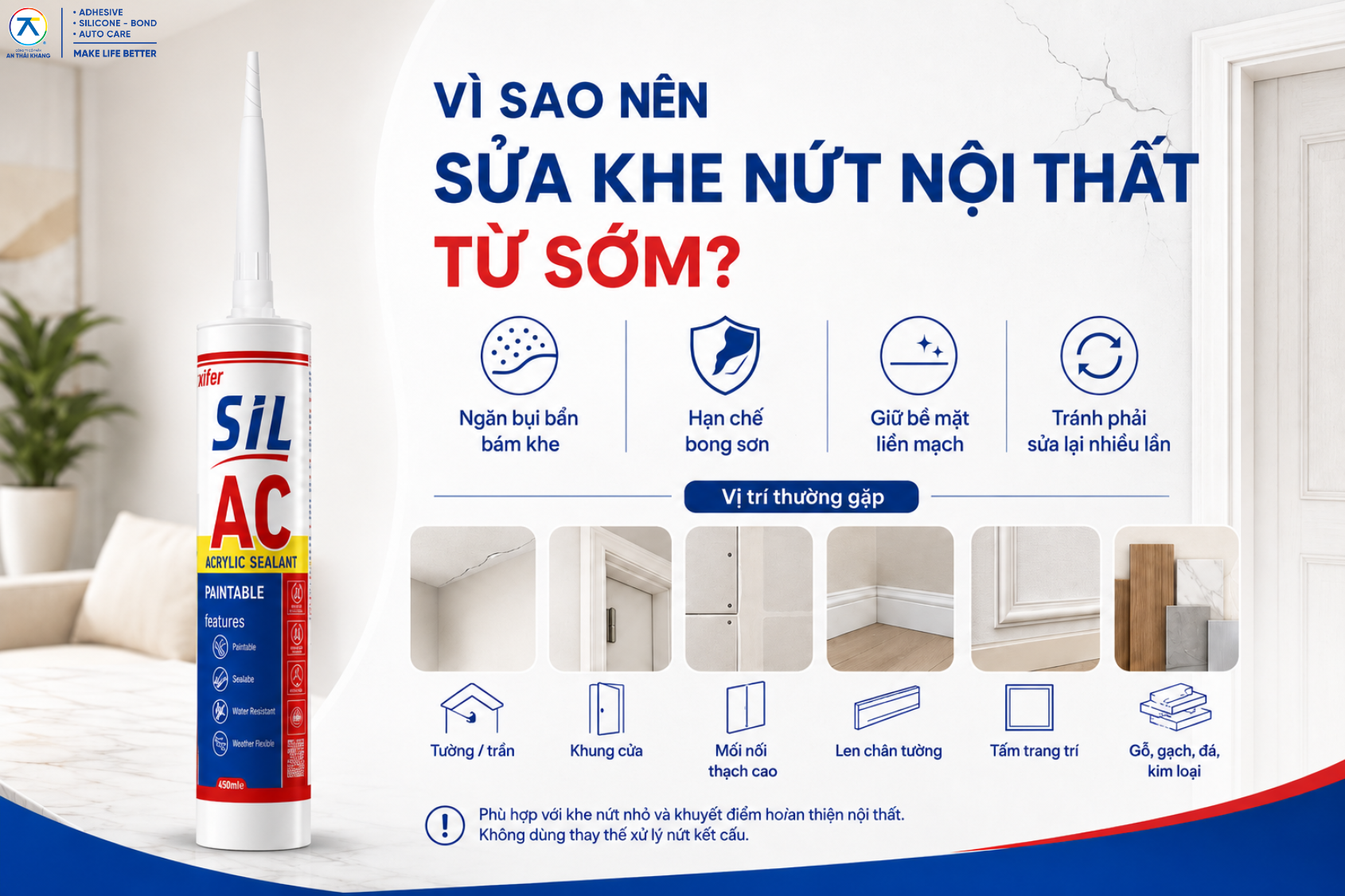
Small cracks in walls or ceilings are often overlooked because they do not immediately affect daily activities. However, over time, dust may accumulate inside the cracks, the surrounding paint may begin to peel, and the cracks may become increasingly visible.
Gaps may also develop at junctions between different materials due to installation tolerances or slight material expansion and contraction. Common locations include door-frame edges, skirting boards, decorative mouldings, decorative panels, and plasterboard joints.
If paint alone is used to cover the defect, the crack may temporarily disappear, but the underlying gap will remain. After a short period, the crack may reappear through the newly applied paint layer.
A more appropriate method is to remove any loose paint or damaged material, clean the gap thoroughly, fill the void, and then apply the finishing coat. Following the correct repair sequence helps create a stable and seamless surface while reducing the likelihood of repeated repairs.
Interior areas that may be treated using sealing and filling methods include:
Small cracks in walls or ceilings.
Joints between walls and door frames.
Joints between plasterboard panels.
Edges of decorative mouldings and skirting boards.
Gaps between walls and decorative panels.
Small gaps between wood, brick, stone, or metal surfaces.
Nail holes and defects left after fittings or accessories have been removed.
However, the severity of the crack must be assessed before any repair work begins. Sealants are suitable for finishing defects and small gaps, but they are not a substitute for structural repair solutions in cases involving large cracks, cracks extending through the wall, or cracks that continue to widen.
2. Which Applications Is SIL AC Sealant Suitable For?
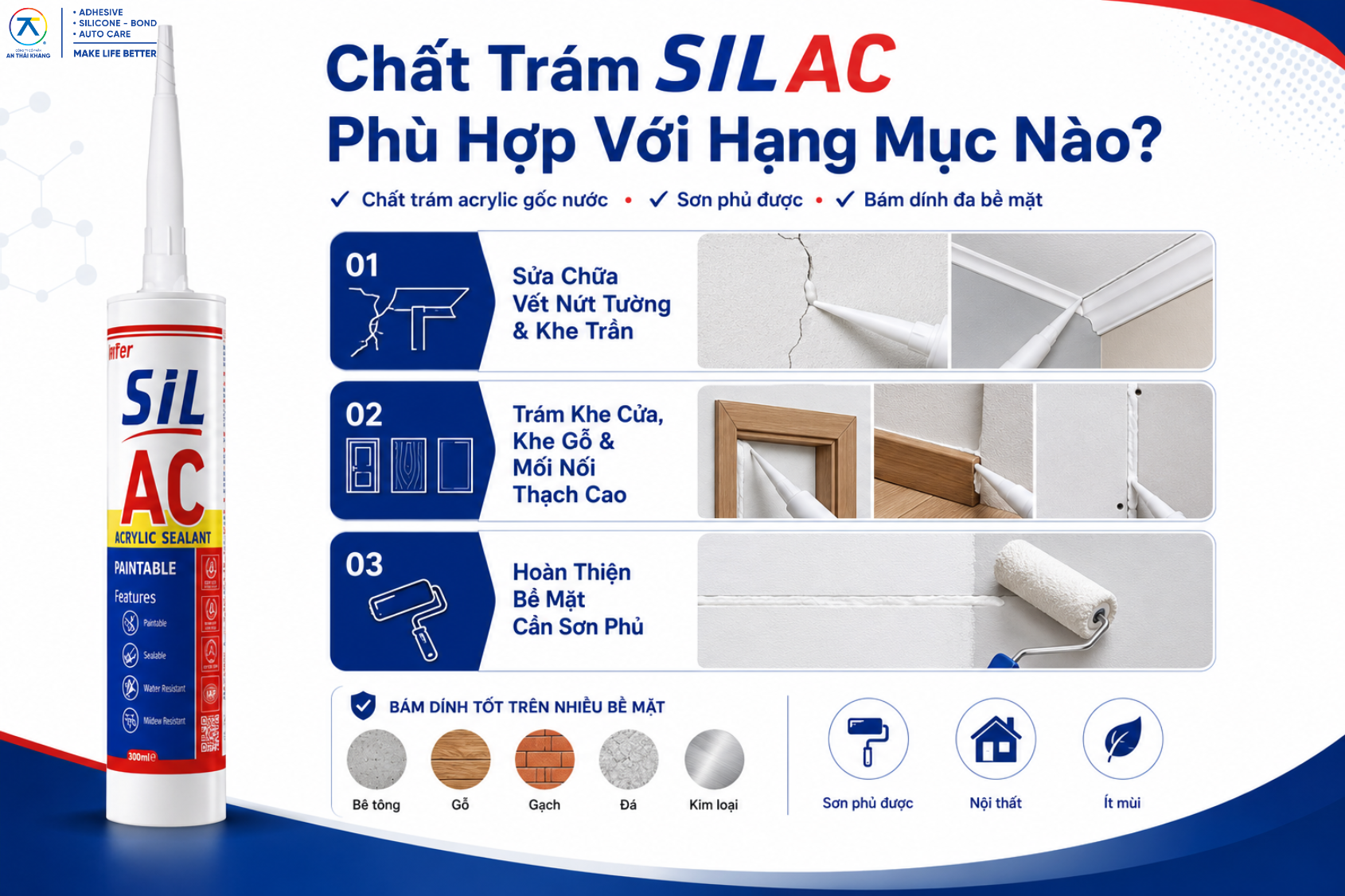
SIL AC Sealant is a one-component, water-based acrylic sealant with an opaque white appearance. It can adhere to a wide range of construction surfaces, including concrete, wood, brick, stone, and metal.
After curing, the sealed joint can be painted to match the surrounding wall, ceiling, or finishing material. This feature makes the product suitable for interior repairs where a neat appearance and minimal visible repair marks are required.
2.1. Repairing Wall Cracks and Ceiling Gaps
Small cracks in walls or ceilings may occur in the paint layer, skim coat, or junctions between different materials. Provided that the crack is stable and is not related to a structural issue, the area may be cleaned and resealed using a suitable material.
SIL AC Sealant helps fill the void and restore the surface before painting. Its flexibility allows the sealed joint to accommodate minor material movement more effectively than simply applying a layer of paint over the crack.
Before application, dust and loose or weakened material inside the crack must be removed. If the crack is extremely narrow, the opening may be widened slightly so that the sealant can penetrate deeper rather than remaining only on the surface.
Once the material has dried and cured, the repaired area can be repainted to create a uniform appearance with the surrounding wall or ceiling.
2.2. Sealing Door-Frame Gaps, Timber Joints, and Plasterboard Joints
Gaps between a door frame and a wall are common in interior finishing work. They may result from installation tolerances, uneven wall surfaces, or differences in expansion and contraction between the door frame and the surrounding construction materials.
Provided that the gap is within a suitable size range, sealant can be applied to fill the opening and create a cleaner joint line. Once painted, the repaired area will be less noticeable and will have minimal impact on the overall appearance of the space.
SIL AC Sealant may also be used for:
Joints between plasterboard panels.
Junctions between decorative mouldings and walls.
Small gaps around decorative panels.
Junctions between timber components and walls.
Gaps between brick, stone, or metal components and construction surfaces.
Its ability to adhere to multiple types of material makes the product suitable for repair applications where different surfaces meet at the same location.
2.3. Finishing Surfaces That Require Painting
One of the key advantages of acrylic sealant in interior repair applications is that it can be painted over after curing.
The sealant initially has an opaque white appearance. Once the material has stabilized and fully cured, it can be painted to match the surrounding wall, ceiling, door frame, or decorative element.
As a result, the repaired area will not remain visible as a sealant line with a contrasting colour. This is particularly important in living rooms, bedrooms, offices, retail stores, and other areas where visual appearance is a priority.
The product is water-based, solvent-free, and does not produce the strong or unpleasant odours associated with some solvent-based products. These characteristics make indoor application more convenient.
3. Interior Repair Procedure Using SIL AC Sealant
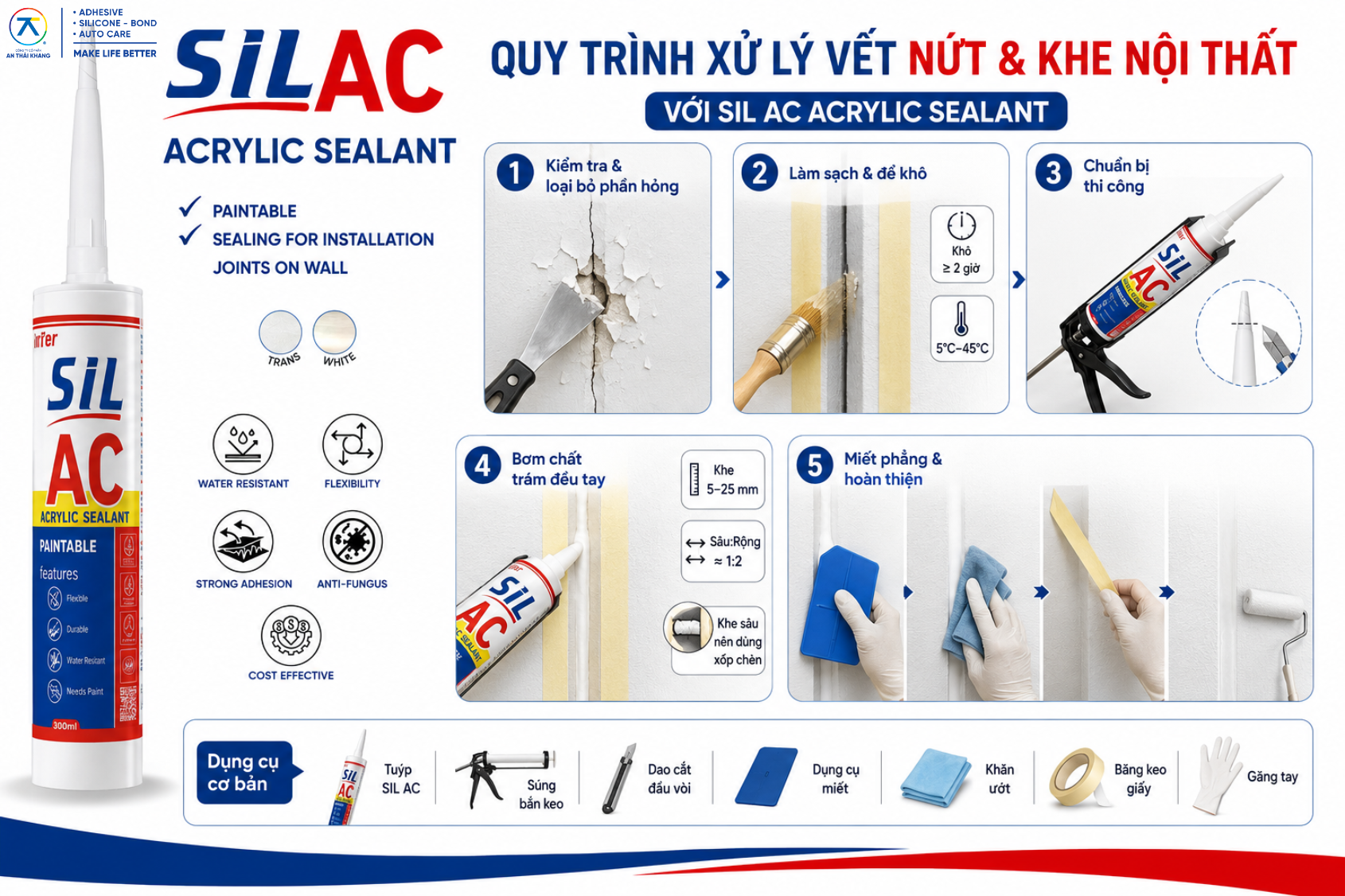
The quality of a sealed joint depends not only on the material itself but also on proper surface preparation and application techniques.
First, inspect the condition of the gap or joint. If the existing paint is peeling, the skim coat is loose, or the old sealant has deteriorated, these materials should be removed before applying new sealant.
The surface must be clean, dry, and free from grease or oil. According to the product instructions, the joint should remain dry for at least two hours before application. The recommended application temperature ranges from 5°C to 45°C.
Basic tools and materials include:
A cartridge of SIL AC Sealant.
A caulking gun.
A knife for cutting the nozzle.
A sealant finishing tool.
A damp cloth.
Masking tape.
Protective gloves.
After cleaning the gap, masking tape may be applied along both edges. The tape helps define the application area, prevents the sealant from spreading onto the surrounding surface, and produces a straighter and neater finished joint.
Next, place the sealant cartridge into the caulking gun and cut the nozzle to match the size of the gap. The nozzle opening should not be excessively large, as this will make the material flow difficult to control. However, it should not be too small, as the sealant may then fail to fill the joint completely.
During application, hold the gun at a consistent angle and move it at a steady speed. Maintain continuous pressure on the trigger to prevent breaks in the sealant bead and avoid areas with uneven thickness.
The product is suitable for joints ranging from 5 mm to 25 mm in width. The recommended depth-to-width ratio is approximately 1:2. For excessively deep joints, a suitable backing material should be considered instead of filling the entire depth with an excessively thick layer of sealant.
Immediately after application, use a finishing tool to press the sealant firmly against both sides of the joint. This process also removes excess material and smooths the surface.
Finishing should be carried out within the first three to five minutes, while the sealant remains easy to shape. Any excess uncured material can be removed using a damp cloth.
Where masking tape has been used, it should be removed immediately after finishing and before the sealant begins to form a surface skin. The sealant should not be touched, rubbed, or painted before it has fully cured.
Once the surface has stabilized, inspect the repaired area for evenness, carry out minor finishing work where necessary, and apply the final paint coating. It is advisable to test the paint on a small section first to confirm compatibility and assess the final colour after drying.
4. Important Considerations When Selecting and Using Sealant
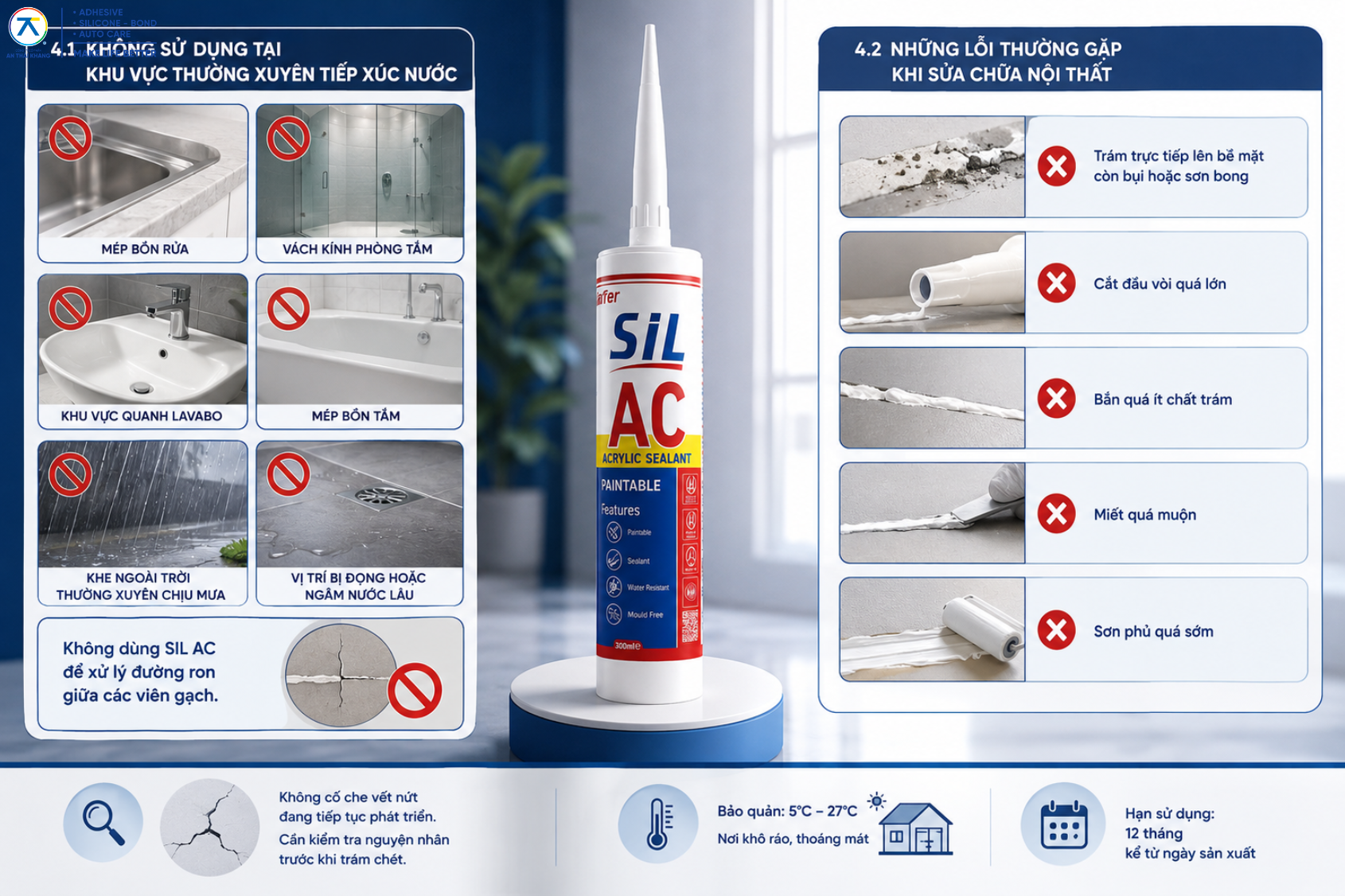
Not every crack or gap can be treated using the same product. Correctly identifying the intended application will improve joint durability and reduce the risk of detachment, cracking, or repeated repairs.
4.1. Do Not Use in Areas Frequently Exposed to Water
SIL AC Sealant is suitable for dry indoor applications. It is not recommended for joints that are frequently exposed to water or continuously submerged.
Therefore, the product should not be used as a substitute for waterproof sealant in the following areas:
Edges around kitchen sinks.
Shower enclosures and glass partitions.
Areas around washbasins.
Bathtub edges.
Outdoor gaps regularly exposed to rain.
Locations subject to standing water or prolonged immersion.
For these areas, a sealant with appropriate water-resistance properties and characteristics suitable for the operating environment should be selected.
SIL AC Sealant should also not be used for joints between tiles. Tile joints require a specialized grouting material capable of meeting the necessary requirements for hardness, stain resistance, and actual service conditions.
4.2. Common Mistakes in Interior Repair Work
The first common mistake is applying sealant directly onto a dusty surface or over peeling paint. When the substrate is unstable, the sealant may adhere to the weakened material rather than bonding securely to the wall or both sides of the joint.
The second mistake is cutting the nozzle opening too large. Excessive material may flow from the nozzle, making the bead difficult to control, increasing the risk of smearing, and requiring additional cleaning time.
The third mistake is applying insufficient sealant. When the material covers only the opening of the joint without filling the internal void, the repaired area may quickly become recessed or separate from the surface.
The fourth mistake is finishing the sealant too late. Once a surface skin has begun to form, further tooling may pull or wrinkle the material and prevent the joint from achieving a smooth finish.
The fifth mistake is painting too early. Sealant that has not fully stabilized may continue to shrink or change condition, potentially affecting the paint layer above it.
Users should also avoid attempting to conceal a crack that is continuing to develop. If large diagonal cracks, through-wall cracks, water penetration, wall swelling, or rapidly recurring cracks are observed, the underlying cause must be investigated before any filling or sealing work is carried out.
Any unused product should be sealed securely at the nozzle and stored in a dry, well-ventilated location. The recommended storage temperature ranges from 5°C to 27°C. SIL AC Sealant has a shelf life of 12 months from the date of manufacture.
5. Conclusion
Interior repair work does not necessarily need to be complicated or require the dismantling of multiple components. For small cracks, wall and ceiling gaps, plasterboard joints, decorative moulding edges, and gaps around door frames, proper sealing and filling can create a neater and more uniform finished surface.
SIL AC Sealant is suitable for various dry indoor applications because of its water-based acrylic formulation, its ability to adhere to multiple materials, and its paintability after curing.
To achieve the best results, the surface must be cleaned thoroughly, a sufficient amount of material must be applied inside the joint, the sealant must be finished within the appropriate working time, and it must be allowed to stabilize fully before painting.
More importantly, the product’s intended scope of application must be clearly understood. SIL AC is suitable for filling, sealing, and interior repair work, but it should not be used in areas frequently exposed to water, between tile joints, or on cracks that may indicate structural problems.
When used in the correct location and applied using the proper technique, SIL AC Sealant makes the repair process faster and cleaner, minimizes dust, and helps restore a smooth, seamless, and professionally finished interior surface.
AN THAI KHANG JSC
- • Fanpage: An Thái Khang JSC
- • Hotline: 0764 644 245
- • Email: support@anthaikhang.com
- • Website: https://anthaikhang.com/