
Sound Insulation for Ventilation Ducts with Spray Adhesive S-Bond Super 8
Explore how white Spray Adhesive S-Bond Super 8 uses a particle spray pattern to support faster, more even bonding of duct sound insulation materials.
1. What Should You Consider When Insulating Ventilation Ducts Against Noise?
In buildings equipped with HVAC systems, ventilation ducts play an essential role in transporting and distributing airflow between different areas.
However, these systems can also transmit sound or vibrations if they are not properly treated. Therefore, sound insulationis often considered during the installation of insulation materials around or on the exterior surfaces of ductwork.
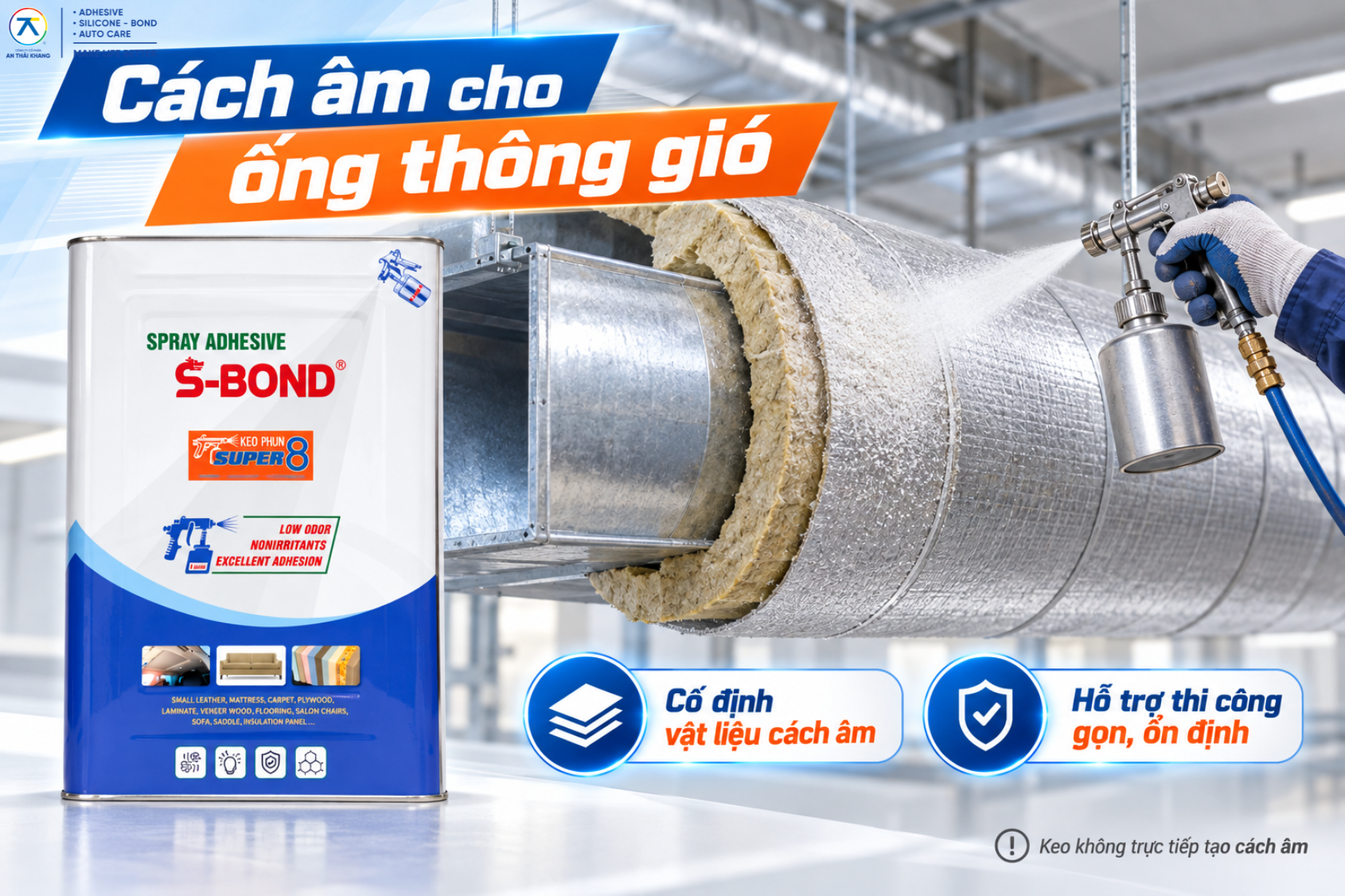
One common approach is to combine sound insulation materials with spray adhesive to secure the insulation layer to the required surface.
Spray Adhesive S-Bond Super 8 is white and features a particle spray pattern, making it suitable for applications that require adhesive coverage over relatively large areas, such as ventilation duct surfaces or insulation panels used in sound insulation projects.
It is important to note that the adhesive itself does not provide sound insulation. Its primary function is to help bond sound insulation materials to the application surface, contributing to a neater and more stable installation.
2. Why Is Spray Adhesive Suitable for Sound Insulation Applications?
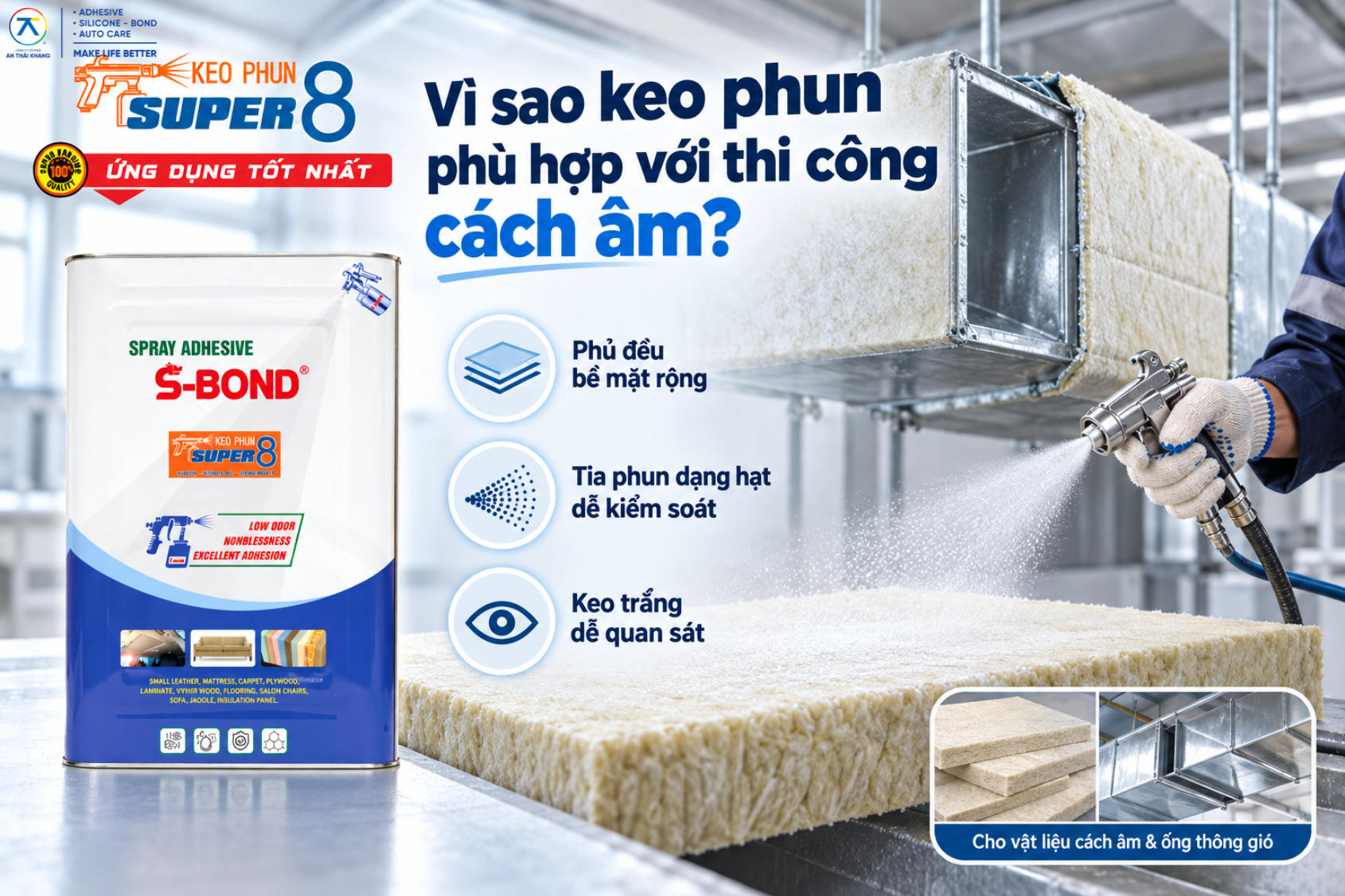
Materials used for sound insulation and sound absorption often have relatively large surface areas. When adhesive is applied manually with a brush, achieving even coverage can be challenging and may require more time, especially when working with large quantities of materials.
Spray adhesive allows installers to apply adhesive across wider areas, making it more convenient to prepare insulation layers before attaching them to ducts or metal surfaces.
Spray Adhesive S-Bond Super 8 features a particle spray pattern. This spray pattern distributes adhesive in numerous small spots across the surface rather than concentrating it in a continuous line.
For sound insulation applications involving ventilation ducts, this application method helps installers control the spray coverage more easily, particularly when working on large surfaces or performing continuous installation tasks.
The adhesive's white color can also make it easier to observe the applied adhesive on certain light-colored materials during installation.
3. Applications of Spray Adhesive S-Bond Super 8 in Ventilation Duct Installation
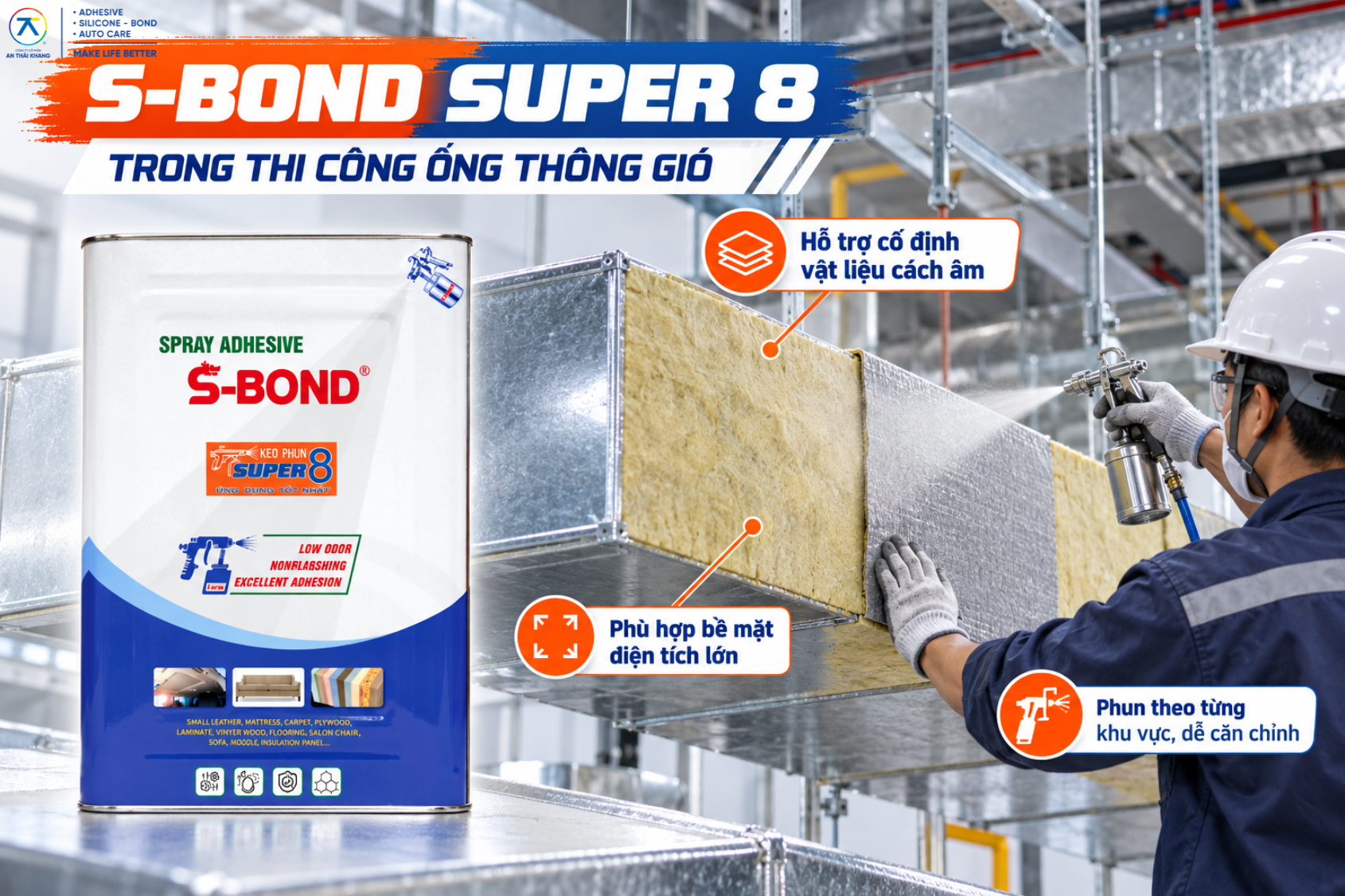
In ventilation systems, sound insulation materials may be installed in areas where sound transmission needs to be reduced or operational noise needs to be controlled.
Spray Adhesive S-Bond Super 8 can be used to help secure insulation layers to suitable surfaces before proceeding with subsequent finishing steps.
3.1. Supporting the Bonding of Sound Insulation Materials
Materials such as mineral wool, acoustic fibers, and other specialized insulation layers often need to remain securely positioned throughout installation.
Spray adhesive helps create a bond between the insulation material and the underlying surface, reducing the likelihood of the material shifting during handling and installation.
For large duct systems, applying adhesive section by section also gives installers greater control when positioning and adjusting insulation materials.
3.2. Suitable for Large Surface Areas
Ventilation ducts often include long sections or large, flat surfaces. When adhesive is applied unevenly, some areas may receive insufficient coverage while others may accumulate excess adhesive.
The particle spray pattern of Spray Adhesive S-Bond Super 8 allows for more flexible adhesive application across these surfaces.
Dividing the installation area into smaller sections, applying adhesive to each section, and then positioning the insulation material can also make the assembly process easier to manage.
4. How to Effectively Combine Adhesive with Sound Insulation Materials
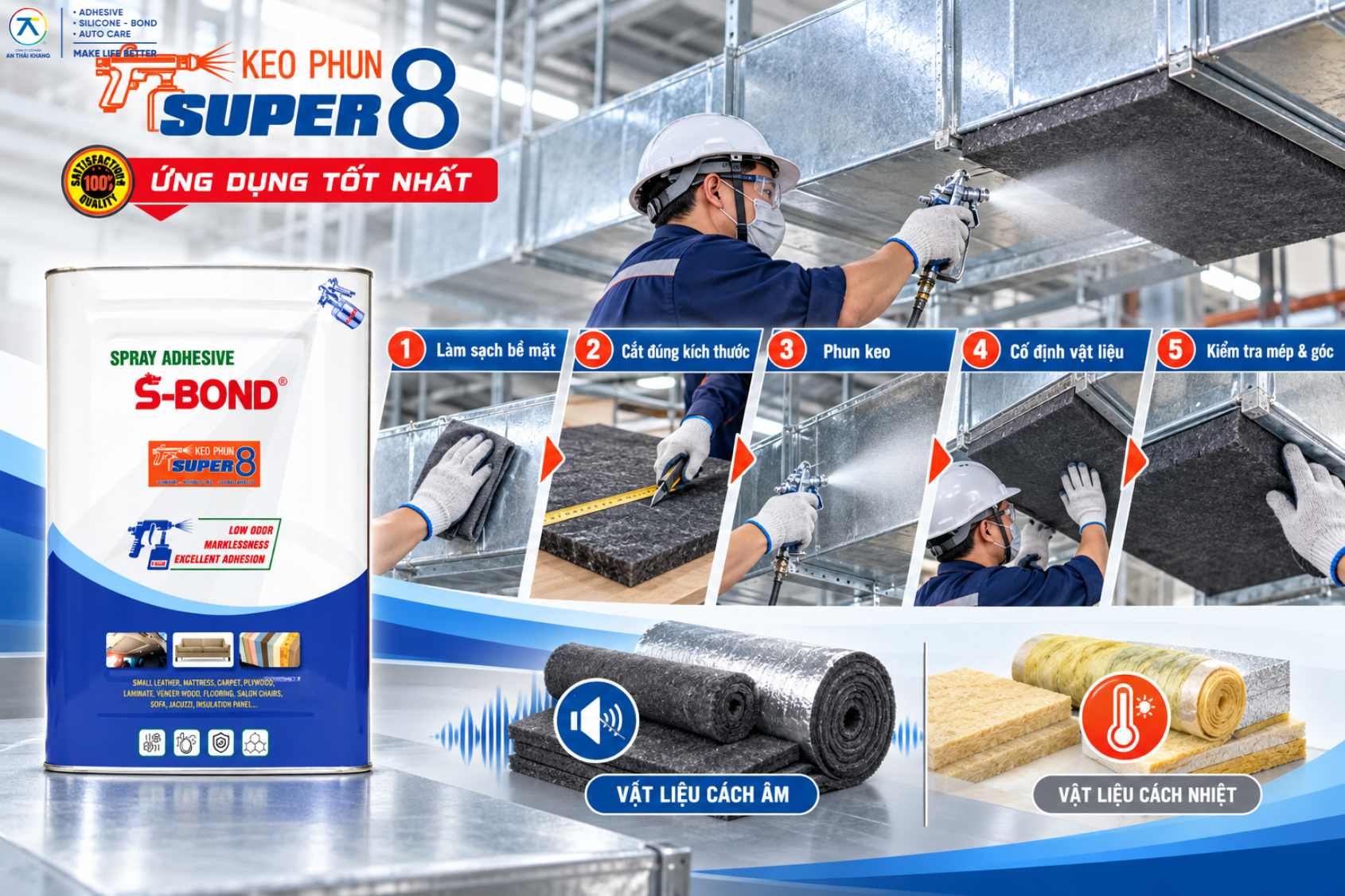
The effectiveness of a sound insulation layer depends on both the materials used and the installation method.
Before applying the adhesive, surfaces should be inspected and cleaned to remove dust, oil, or other contaminants that could interfere with contact between the adhesive and the materials.
Sound insulation materials should be cut to match the dimensions of the installation area before adhesive application. Test-fitting the materials beforehand helps minimize repeated adjustments after the adhesive has been sprayed.
In addition, sound insulation materials and thermal insulation materials may differ in their composition and application requirements. Therefore, it is important to identify the intended purpose of each material layer rather than assuming that one type can automatically replace the other.
After applying Spray Adhesive S-Bond Super 8, the insulation material should be positioned correctly and kept stable while the bond develops.
Edges, corners, and transition areas should be carefully inspected, as these locations are more likely to experience misalignment or gaps if the materials are not installed evenly.
5. Important Considerations When Using Spray Adhesive S-Bond Super 8 for Sound Insulation
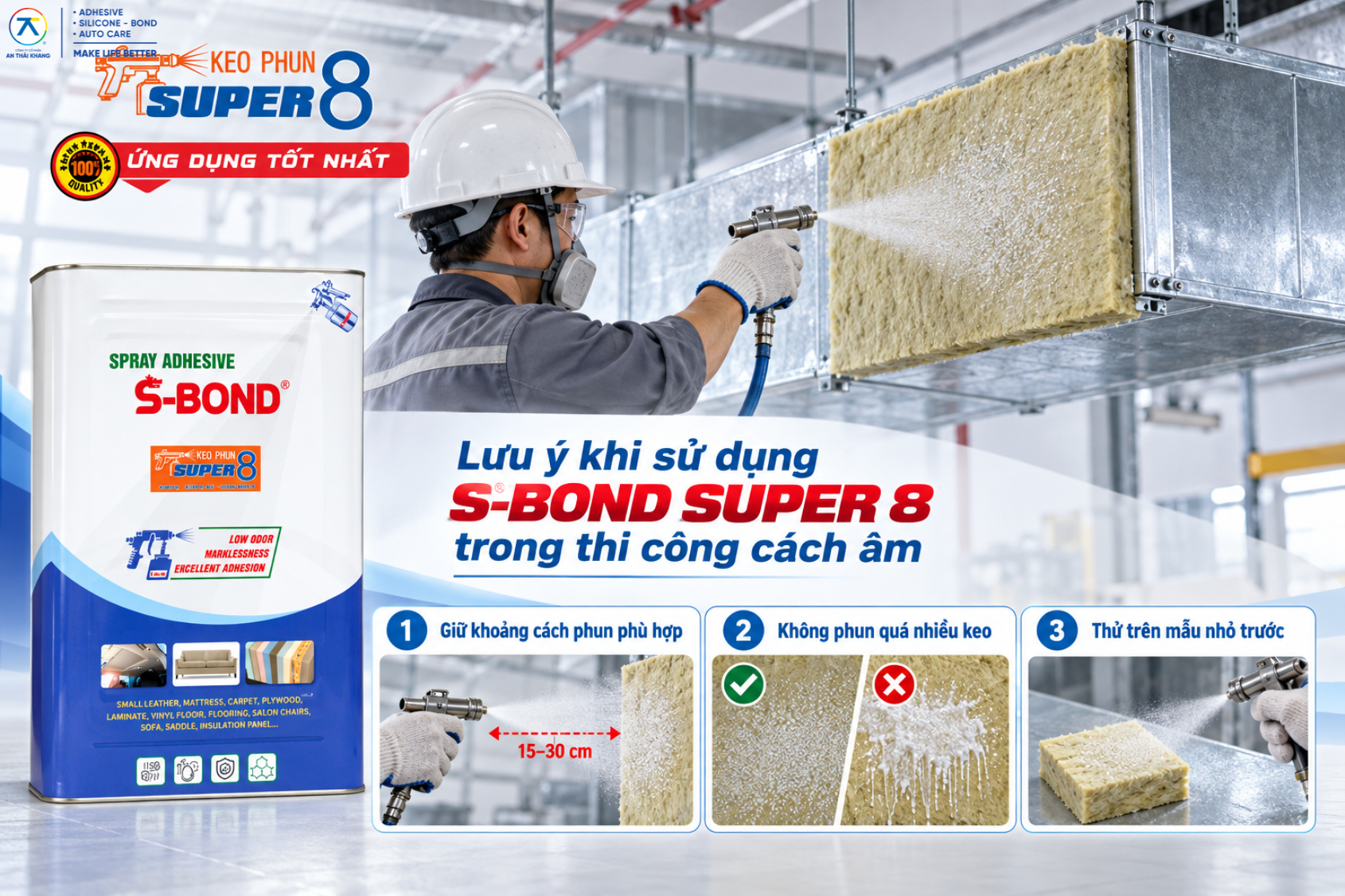
Spray adhesive can help speed up the application process. However, proper application techniques are still essential to achieve neat and consistent adhesive bonding.
5.1. Maintain an Appropriate Spraying Distance
The distance between the spray nozzle and the application surface affects how the adhesive is distributed.
If the nozzle is held too close to the surface, the adhesive may become concentrated in a small area. If it is held too far away, the adhesive may spread beyond the intended application zone.
Therefore, it is advisable to test the spray pattern on a small area first to determine the most suitable application technique for the actual surface.
5.2. Avoid Applying Too Much Adhesive
The particle spray pattern distributes adhesive across the surface in numerous small spots. Installers do not need to create an excessively thick adhesive layer over the entire surface.
Applying an appropriate amount of adhesive helps minimize excess adhesive, reduce cleaning requirements, and maintain a neater working surface.
After applying the adhesive, edges and corners should be checked again to ensure that the insulation material remains correctly positioned.
5.3. Test Material Compatibility Before Large-Scale Installation
Some sound insulation systems use fiberglass, mineral wool, or other types of insulation materials.
Since each material may have different surface characteristics, it is advisable to test the adhesive's bonding performance on a small sample before proceeding with the entire installation.
This is particularly important for projects involving multiple material types or specific surface finishing requirements.
6. Conclusion
Sound insulation for ventilation duct systems depends not only on the type of insulation material used but also on selecting a suitable bonding method to keep the material securely positioned during installation.
Spray Adhesive S-Bond Super 8, with its white adhesive and particle spray pattern, supports adhesive distribution across large surfaces, making it suitable for bonding sound insulation materials to ventilation duct systems and similar applications.
Its flexible spray pattern allows installers to divide work areas into manageable sections, control the amount of adhesive applied, and maintain cleaner surfaces throughout installation.
When combined with suitable sound insulation materials, properly prepared surfaces, and appropriate spraying techniques, Spray Adhesive S-Bond Super 8 can serve as a convenient bonding solution for contractors working on large surface areas where consistent installation efficiency is important.
AN THAI KHANG JSC
- • Fanpage: An Thái Khang JSC
- • Hotline: 0764 644 245
- • Email: support@anthaikhang.com
- • Website: https://anthaikhang.com/