
Simplify Machine Component Repairs with RTV Gasket Sealant
Learn how to repair mating surfaces, leakage points, and areas requiring new gaskets on machinery using S-BOND RTV Gasket Sealant, creating a flexible, heat-resistant, and reliable seal.
During operation, mating surfaces on machinery may need to be disassembled for maintenance, cleaning, or component replacement. When the parts are reassembled, the gasket between the two surfaces plays an important role in maintaining a tight seal and preventing oil, gas, or water from escaping through the joint.
Instead of preparing pre-cut rubber gaskets for every specific shape, RTV gasket sealant allows users to form a gasket directly according to the contour of the component. This method is particularly convenient when repairing machinery with multiple mating surfaces, bolt holes, or irregular shapes.
S-BOND RTV Gasket Sealant is an RTV silicone designed for gasket making, sealing, gap filling, and mechanical sealing applications. Available in red and grey, it withstands temperatures of up to approximately 343°C (650°F) and forms a flexible gasket that adheres to various surfaces, including metal, anodized aluminum, epoxy, polyester, polystyrene, and wood.
1. Effective Sealing Repairs Start with the Gasket
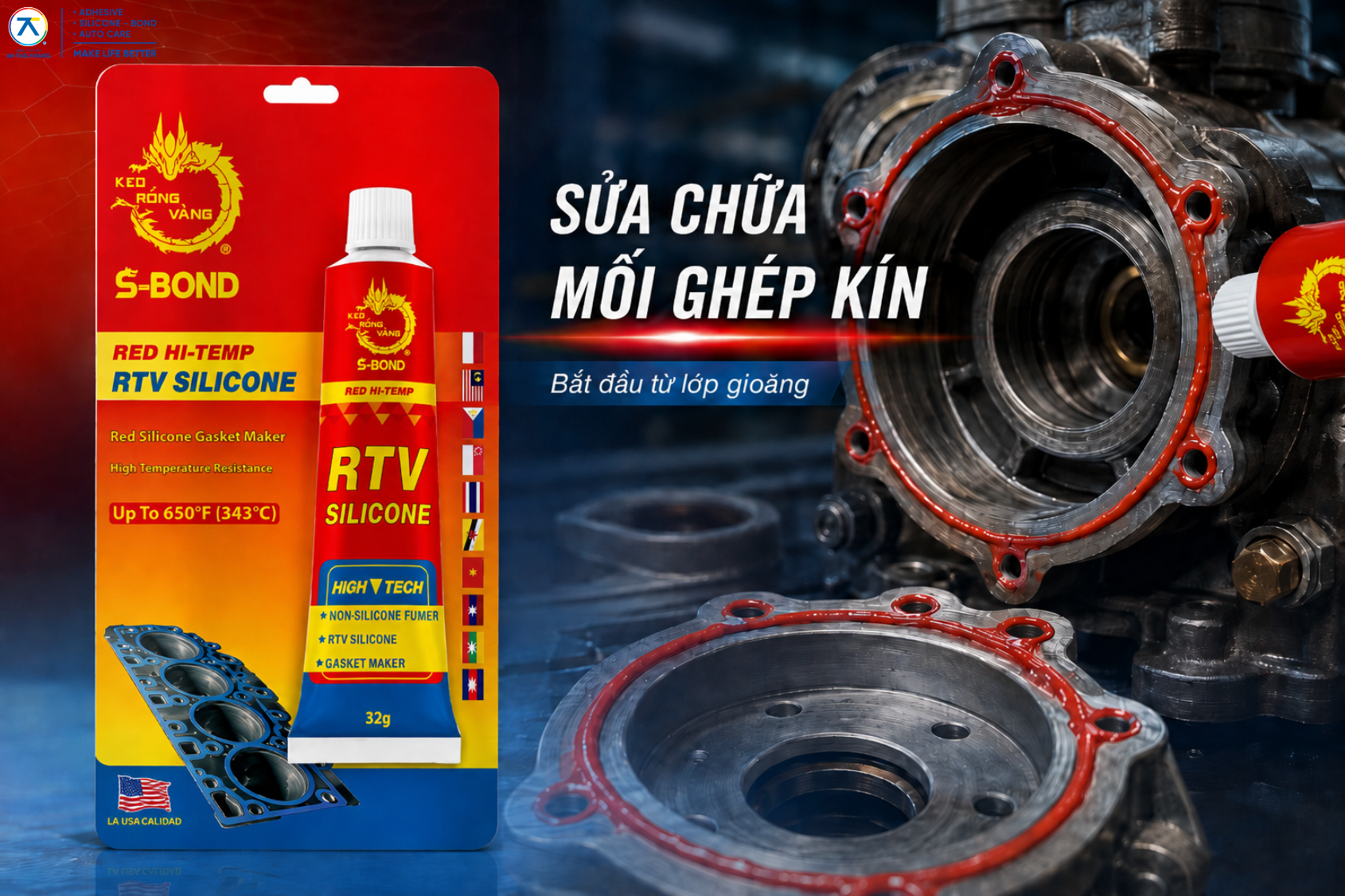
In mechanical equipment, many components are not assembled with direct metal-to-metal contact. A gasket is often placed between two mating surfaces to compensate for small gaps and maintain a reliable seal during operation.
After extended use or whenever a component is disassembled, the existing gasket may need to be replaced. At this stage, accurately recreating the gasket path becomes an important part of the repair process.
S-BOND RTV Gasket Sealant can be used to create gaskets for:
Mating surfaces of machine components.
Areas around bolt holes.
Compressors and compressed-air tanks.
Generators.
Engines and mechanical equipment.
Heating chambers and industrial furnaces.
Gas pipes and other areas requiring sealing.
Once cured, the silicone bead forms a flexible sealing layer that helps maintain a tight joint while accommodating vibration during machine operation. Its high-temperature resistance also makes the product suitable for many areas that regularly operate under elevated temperatures.
Another advantage is that the gasket can be formed directly according to the shape of the component. The technician simply applies the sealant around the perimeter of the mating surface and other areas requiring sealing, instead of cutting a gasket sheet to match a complicated profile.
2. Applications Where S-BOND RTV Offers Greater Flexibility

2.1. Recreating Gaskets on Machine Mating Surfaces
When a machine assembly is disassembled for maintenance, the old gasket is usually removed before the components are reassembled. Once both surfaces have been thoroughly cleaned, S-BOND RTV Gasket Sealant can be applied as a continuous bead around the mating edge.
A bead width of approximately 2–4 mm is recommended to create an even gasket layer after the two surfaces are assembled. The sealant should also be applied around bolt holes so that the gasket remains continuous throughout the entire area requiring sealing.
This direct gasket-forming method is particularly suitable for components with multiple corners, curves, or unique contours. Technicians can follow the exact shape of the mating surface instead of having to fabricate a new pre-cut gasket.
2.2. Sealing Small Gaps in Equipment
Not every repair requires complete disassembly of the machine. In some cases, only a small gap or joint needs to be resealed to maintain proper tightness.
Because S-BOND RTV is a silicone sealant, it can easily be applied as a continuous bead along edges, corners, and complex-shaped components. Once cured, the material remains flexible rather than forming a completely rigid joint.
This characteristic makes it suitable for areas exposed to vibration during operation, such as compressors, generators, and various types of mechanical equipment. The gasket layer helps maintain sealing performance against oil, gas, and water within the system.
2.3. Sealing High-Temperature Areas
Temperature is an important factor to consider when repairing mechanical equipment. S-BOND RTV Gasket Sealant can withstand temperatures of up to approximately 650°F (343°C), making it suitable for applications such as industrial furnaces, heating chambers, gas pipes, and certain machine assemblies that generate high levels of heat.
Its combination of heat resistance and flexibility helps the gasket maintain its shape under operating conditions involving temperature fluctuations.
As a result, one product can support applications ranging from routine machinery maintenance to gasket-making tasks in industrial environments.
3. What Makes RTV Gasket Sealant Different in Application
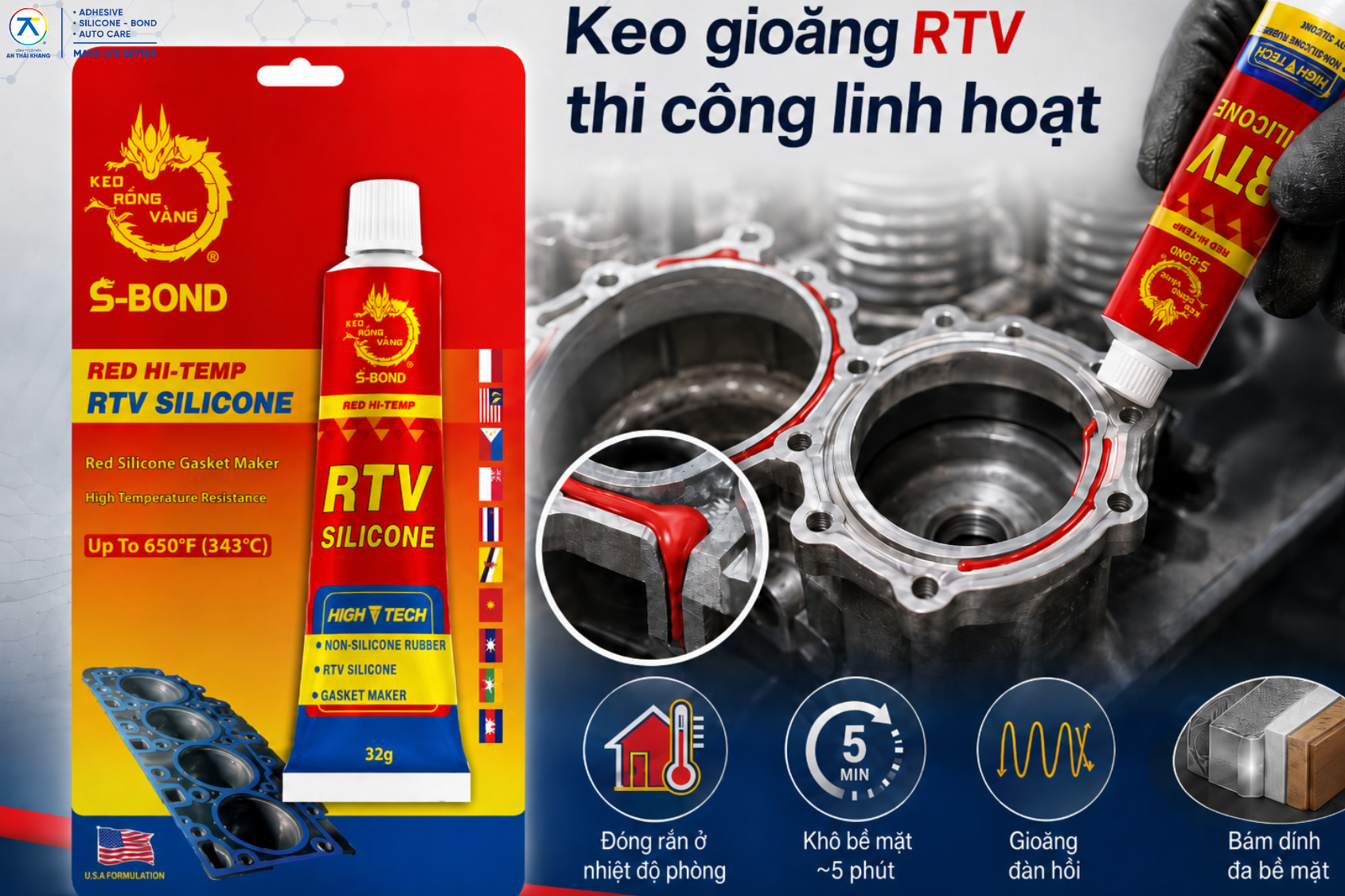
RTV stands for Room Temperature Vulcanizing, referring to silicone materials that cure at room temperature. With S-BOND RTV Gasket Sealant, users can form a gasket directly at the repair area without applying external heat to cure the sealant.
The sealant begins to become surface-dry after approximately 5 minutes. This provides a convenient working window for applying the bead, aligning the two mating surfaces, and completing the assembly.
Another advantage is the flexibility of the silicone after curing. Machine mating surfaces may be exposed to vibration, heat, and slight movement during operation. A flexible gasket can accommodate these changes more effectively than a completely rigid sealing material.
S-BOND RTV Gasket Sealant can also adhere to various types of surfaces, including:
Metal.
Anodized aluminum.
Epoxy.
Polyester.
Polystyrene.
Wood.
This versatility allows the product to be used for a wide range of maintenance and repair applications rather than being limited to one particular type of equipment.
RTV belongs to the silicone material family and should not be confused with elemental silicon. Although the two terms sound similar, their structures and applications are completely different. Silicone is flexible and is therefore widely used in sealants, gaskets, and other sealing materials.
4. How to Recreate a Gasket During Machinery Repair
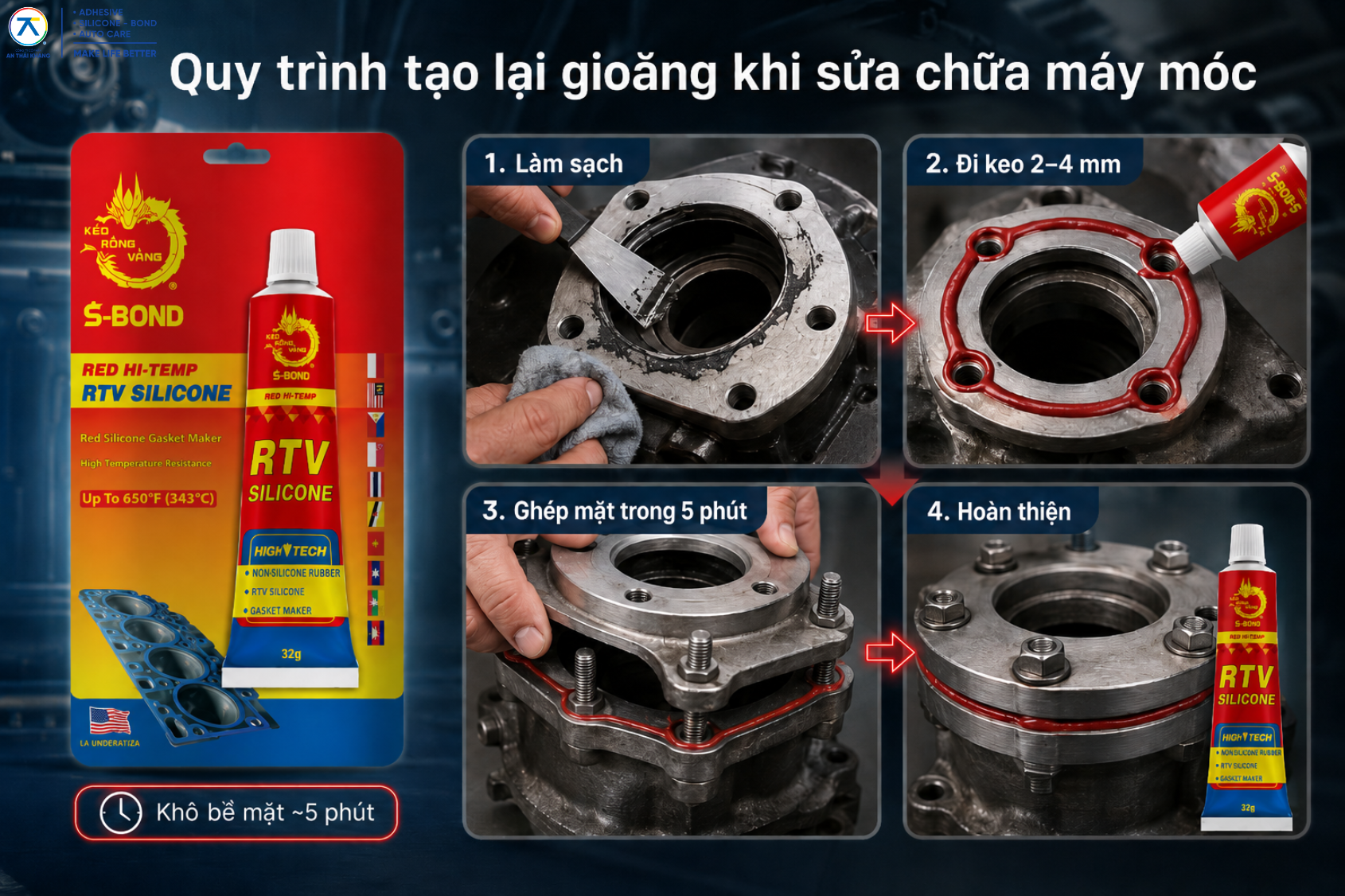
A properly applied gasket bead should be continuous, even, and positioned correctly. The entire process can be completed in a few straightforward steps.
4.1. Remove the Old Gasket
After disassembling the component, completely remove any old sealant or gasket material remaining on both mating surfaces.
Use suitable tools to remove the old material, then wipe the surfaces clean to eliminate dust and contaminants. Both surfaces should be dry before applying the new sealant.
The preparation process does not need to be overly complicated. The most important requirement is to ensure that the contact area is clean so that the new silicone bead can be applied directly to the surface that needs to be sealed.
4.2. Apply a Continuous 2–4 mm Bead
Cut the nozzle to the desired opening size, then apply a continuous bead approximately 2–4 mm wide.
Start at one point and continue around the entire perimeter of the mating surface without interruption. When reaching a bolt hole, apply the sealant around the hole to maintain a completely continuous sealing path.
Maintain relatively consistent pressure while squeezing the tube to keep the gasket bead uniform in thickness. At corners, move slightly more slowly to prevent breaks in the bead.
The process can be easily remembered as:
Clean → Apply Sealant → Encircle Bolt Holes → Join Surfaces → Tighten and Secure
4.3. Assemble the Two Surfaces Within Approximately 5 Minutes
Once the gasket bead has been completed, assemble the two mating surfaces within approximately 5 minutes.
Carefully align the components before pressing the two surfaces together, then tighten the bolts sufficiently to hold the assembly securely in place. As pressure is applied, the silicone spreads and forms a gasket that follows the exact shape of the mating surfaces.
If excess sealant appears along the edges, it can be cleaned while the material is still fresh to achieve a neater finished surface.
The sealant becomes surface-dry after approximately 5 minutes and continues to cure fully over approximately 1–7 days, depending on bead thickness and actual environmental conditions.
4.4. Final Inspection and Storage
After assembly, inspect the entire joint to check the gasket position and identify any excess sealant.
Uncured sealant can be cleaned using MEK or Toluene. After use, tightly close the tube to minimize prolonged exposure of the remaining sealant to air.
S-BOND RTV Gasket Sealant is available in 32 g and 85 g sizes, allowing users to choose the appropriate quantity based on the number of repair points.
The product should be stored in a dry, well-ventilated place at approximately 5–30°C, away from direct sunlight and heat sources. The shelf life is 24 months when stored in unopened packaging.
5. Conclusion
In machinery repair, even a small mating surface that is not properly sealed can affect the overall operation of the equipment. Recreating the gasket with the correct shape and position is therefore an important step that should be carried out carefully.
S-BOND RTV Gasket Sealant provides a flexible solution by allowing the sealant to be applied directly according to the contour of the component. Once cured, it forms a flexible silicone gasket that helps seal mating surfaces, gaps, and areas around bolt holes.
With heat resistance of up to approximately 343°C (650°F), adhesion to multiple materials, and a short surface-drying time, the product is suitable for compressors, generators, mechanical engines, compressed-air tanks, heating chambers, industrial furnaces, and many other types of equipment requiring gasket formation.
By simply preparing clean surfaces, applying an even 2–4 mm bead, assembling the components within approximately 5 minutes, and allowing the silicone to cure for the appropriate period, machinery repair can be carried out more efficiently while maintaining the required sealing performance.
AN THAI KHANG JSC
- • Fanpage: An Thái Khang JSC
- • Hotline: 0764 644 245
- • Email: support@anthaikhang.com
- • Website: https://anthaikhang.com/